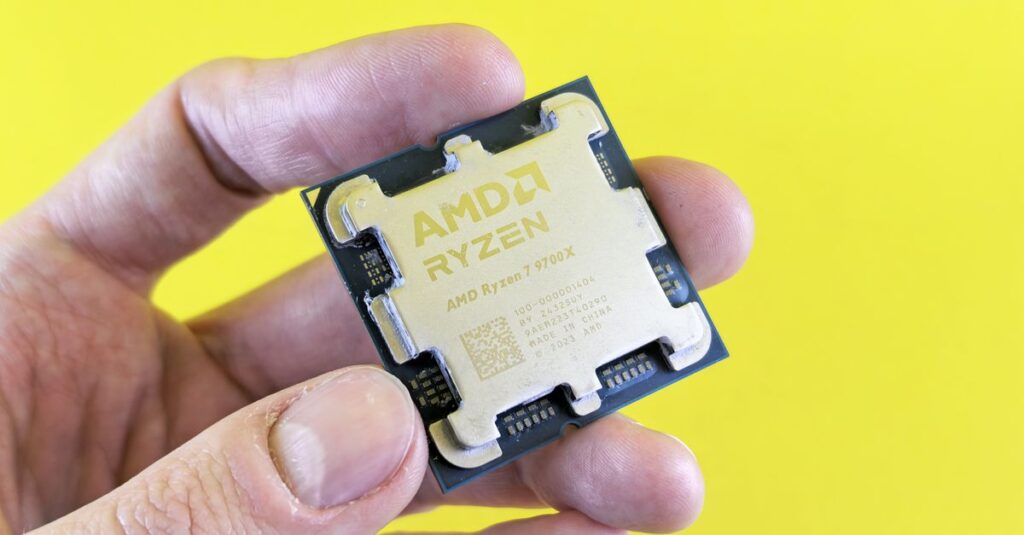
AMD agreed to buy World Labs, the spatial intelligence startup founded by AI pioneer Fei-Fei Li, in an all-stock deal worth about .2 billion, putting the company’s world models and research team to work on AMD’s push against Nvidia in AI computing.
The deal, announced Monday, is expected to close by the end of 2026 pending regulatory approval. Li, the Stanford professor widely credited with catalyzing modern computer vision through the ImageNet database, will join AMD as executive vice president and chief scientist, reporting directly to CEO Lisa Su.
World Labs was founded in 2024 with 30 million in funding, some of it from AMD itself, by Li together with researchers Justin Johnson, Christoph Lassner and Ben Mildenhall. The company builds world models, AI systems that generate and simulate interactive 3D environments from text, image and video inputs, along with technology for robotic learning.
Why AMD wants a model lab
AMD’s own statement pointed at robotics and physical AI rather than content creation. “As AI expands into reasoning, robotics, simulation and physical AI, the demands on compute infrastructure become more diverse,” the announcement read. “World Labs’ expertise in developing advanced models will give AMD deeper insight into how workloads are evolving and help shape its future technology roadmaps.”
Li framed it the same way from her side. “Advancing the next generation of AI technology requires close collaboration across model research, systems and compute,” she said. “Joining AMD will give our team the resources and engineering depth to accelerate our research and help define the infrastructure needed for the next era of AI.”
The strategic logic is straightforward. Nvidia has spent the past two years building a full stack around its chips: CUDA software, Cosmos world models for robotics simulation, and partnerships across the robotics industry that generate synthetic training data on Nvidia infrastructure. AMD has strong hardware and an open-source software push, but it has never had a model research organization of this caliber. World Labs gives it one, plus the insight into how frontier workloads actually behave, which informs what future chips should look like.
Su said as much in the release: “Building the compute platforms for the next generation of AI requires a deep understanding of how models are evolving.”
What World Labs actually built
The company’s first public product, Marble, generates small 3D spaces using Gaussian splats that export into film production and game development pipelines. It drew attention at this year’s SIGGRAPH conference. A newer model called Atlas extends the approach. But the commercially significant use case is synthetic data for training robots, where generated environments stand in for expensive real-world data collection.
AMD had produced its own open-source world model, Micro-World, but nothing that competed with Nvidia’s Cosmos stack. Buying the leading independent lab in the field closes that gap faster than internal research could.
The two companies already had ties. AMD and World Labs formed an inference optimization and training partnership last year, and Li appeared at AMD’s CES presentation earlier in 2026. The acquisition formalizes what was already a close relationship, and AMD had been an investor since the company’s founding round.
Price and precedent
At $$8.2 billion, the deal ranks among the larger AI acquisitions to date and is striking for a company barely two years old. It also continues a run of consolidation in which large chipmakers and cloud providers absorb promising AI labs rather than compete with them. Nvidia’s own moves up the stack, including its agreement to buy Hugging Face for nearly $$13 billion earlier this month, have put pressure on AMD to respond with depth of its own.
AMD said it plans to keep World Labs operating separately from its chipmaking business until the transaction closes. Co-founders Johnson and Mildenhall will continue leading the World Labs team under Li as it joins AMD to form what the companies call a frontier research organization.
World models remain an early field with genuine technical disagreement about the right approach. Many competing architectures train on vast amounts of video data, while World Labs has emphasized spatial structure and 3D representation. That disagreement is part of why an acquisition makes sense for AMD: rather than betting on one architecture internally, it inherits a lab that has already made its bet and attracted the researchers to pursue it.
The robotics angle also connects to a broader shift in AI spending. Text and image models drove the first wave of data center buildout. The next wave, if it arrives on schedule, will be machines that act in the physical world, and those systems need simulation environments for training that no dataset of internet video can provide. Whoever supplies the models that generate those environments sits close to a large future market for compute, which is exactly the market AMD’s Instinct accelerators are built to serve.
The competitive clock matters too. Nvidia is set to become TSMC’s largest customer this year, displacing Apple, and its data center business keeps compounding. AMD has won design wins with major cloud providers for its MI series accelerators, but software and ecosystem gravity still favor its rival. Buying the research talent that shapes next-generation workloads is a longer-game response than another price cut or another benchmark win.
For Li, the move ends her run as an independent lab founder but keeps her research agenda intact inside a company with the compute budget to pursue it. For AMD, the bet is that the next phase of AI demand, models that understand and simulate physical space, will need hardware designed around those workloads, and that the way to know what those workloads need is to own the people building them.