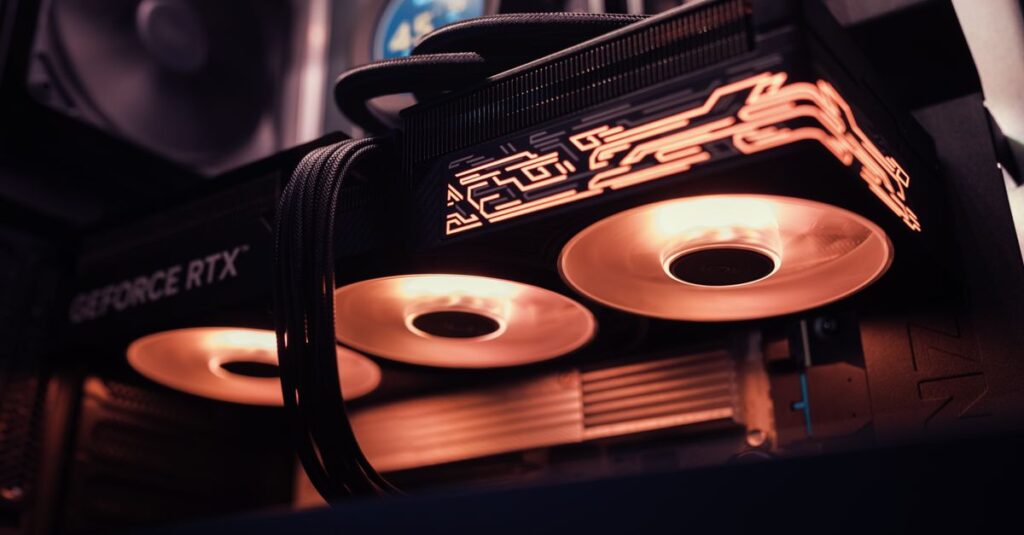
A Chinese financing company controlled by local government entities funded the purchase of restricted Nvidia Blackwell AI chips, according to regulatory filings reviewed by Bloomberg and published on October 2, 2026. The documents, filed with Beijing regulators, undermine the assumption that Chinese state actors are not actively facilitating the trade in restricted semiconductor hardware.
Semi-Tech Leasing Group Co. provided capital for purchases by Glory View Technology Co. of more than 700 servers, totaling more than 3 billion yuan, or about $440 million, in financing arrangements. One contract in the filings specifically covers 32 Asustek Computer Inc. servers, model name XA NB3I-E12, equipped with Nvidia’s B300 chips, part of Nvidia’s Blackwell family that is banned from export to China under US export controls. Most of the servers, including the 32 Blackwell units, are listed as deployed inside a China Mobile Ltd. facility.
How the financing chain works
Glory View, a publicly traded Chinese company, entered its first financing arrangement with Semi-Tech Leasing in August 2025. A series of finance lease agreements followed in the months after. Finance leases let a leasing company buy hardware on behalf of a customer and bill the customer over many years, which spreads out the cost of high-end AI servers and makes a deal with a restricted chip practical where an outright purchase would be an obvious red flag.
Semi-Tech Leasing is owned by several local Chinese government entities. The company’s chairman said at an April financial conference in Shanghai that the firm had deployed more than 11 billion yuan, roughly $1.6 billion, to build what he described as an ecosystem covering model training, chips and other parts of the AI industry. The company’s public filings also state that it ‘spares no effort in serving and supporting national strategy,’ language that in Chinese corporate filings usually signals backing from state industrial policy rather than a private investment thesis.
While hundreds of other servers purchased by Semi-Tech Leasing match the specifications for Nvidia Blackwell chips, the documents do not explicitly identify the hardware beyond the 32 Asus units. The financing chain makes attribution harder because the leaser, the customer, and the end deployment site are all separate entities that can each claim they did not knowingly handle a restricted product. Tracing questions also cut in the other direction: because the finance leases are spread over the customer’s own repayment schedule, the user of the chip and the eventual source of funds do not sit on the same balance sheet, which means auditors looking for suspicious chip purchases have to follow the lease rather than the sale.
What Washington and the companies say
US administrations have tightened export controls on advanced AI chips to China over several years, with the stated aim of limiting progress on large-scale model training. Enforcement has leaned heavily on corporate due diligence and spot audits. Black-market brokers have smuggled billions of dollars worth of Nvidia hardware into China over the past few years, and US officials have described gaps in corporate due diligence and weak local enforcement as the main reason smuggling persists.
Nvidia said it is ‘looking into this report and will work with our OEM customer to investigate.’ Asustek said the company ‘is committed to strict compliance with all applicable laws and regulations, including export controls.’ China Mobile, China’s Ministry of Industry and Information Technology, Semi-Tech Leasing, and Glory View had not responded to requests for comment as of Bloomberg’s publication.
DIGITIMES, which reviewed the story on October 2, noted that a financing chain involving Chinese state entities marks a change from earlier smuggling cases, which tended to involve small private brokers rather than leasing firms with direct local government ownership.
Why scale does not tell the whole story
The Asus order of 32 servers is small in absolute terms. Nvidia sells tens of thousands of Blackwell-class units to cloud providers in a single quarter. What makes the financing chain significant is who was doing the financing and where the hardware ended up. A state-backed leasing firm funding restricted hardware purchases points to official tolerance for the trade rather than a workaround pursued in spite of the state. US officials had previously described the illegal trade as driven mainly by private brokers and gray-market resellers, with enforcement cases centered on individual smugglers rather than institutional financing chains.
The deployment site matters as well. China Mobile is a state-owned telecoms operator, which raises a specific policy question. If a restricted chip physically sits inside a Chinese state-owned network operator’s data center, it suggests either that the financing chain was tolerated or that internal oversight between different branches of the Chinese state did not flag it. Neither option fits the framing US export control officials have used in public testimony.
The enforcement gap
Whether this leads to fresh enforcement action depends on what the Commerce Department can document. An earlier enforcement approach focused on individual smuggling investigations and corporate audits did not surface state-owned financing as a lever. If the pattern is more widespread, it would require different policy tools, including pressure on leasing and financing structures rather than only on chip sales themselves. That could mean screening finance lease counterparties, expanding OEM due diligence obligations, or targeting the local government entities that back leasing firms handling restricted products.
Enforcement faces several practical barriers. The chipmaker is in the United States, the OEM is in Taiwan, the financing firm is in China, and the deployment is inside a Chinese state network. No single regulator has jurisdiction across all four. The Commerce Department can pressure Nvidia on what its OEM partners do at the point of sale, but it has less direct reach over Chinese finance leases or state-owned telecoms infrastructure.
What happens next
For now the practical effect for Nvidia is reputational and regulatory. Nvidia said it is investigating the report and will work with Asustek as the OEM. The company has already faced questions this year over how its chips end up in Chinese data centers despite export rules, and each new disclosure gives US lawmakers fresh material as they weigh further tightening of the export control regime. Asustek’s statement that it is committed to strict compliance is unlikely to end the discussion on its own, given that the filings list its servers as the hardware in question.
The more consequential question is whether this financing chain is a one-off or a template. If Chinese local governments routinely back leasing firms that finance restricted chips, enforcement through individual smuggling cases misses the problem entirely. Whether Washington adjusts its approach depends on how many similar filings surface in the coming months, and on whether more Chinese state enterprises show up in the paper trail.Sources: Bloomberg, October 1, 2026; Taipei Times, October 3, 2026; DIGITIMES Semiconductors briefing, October 2, 2026; Yahoo Finance, October 2, 2026.