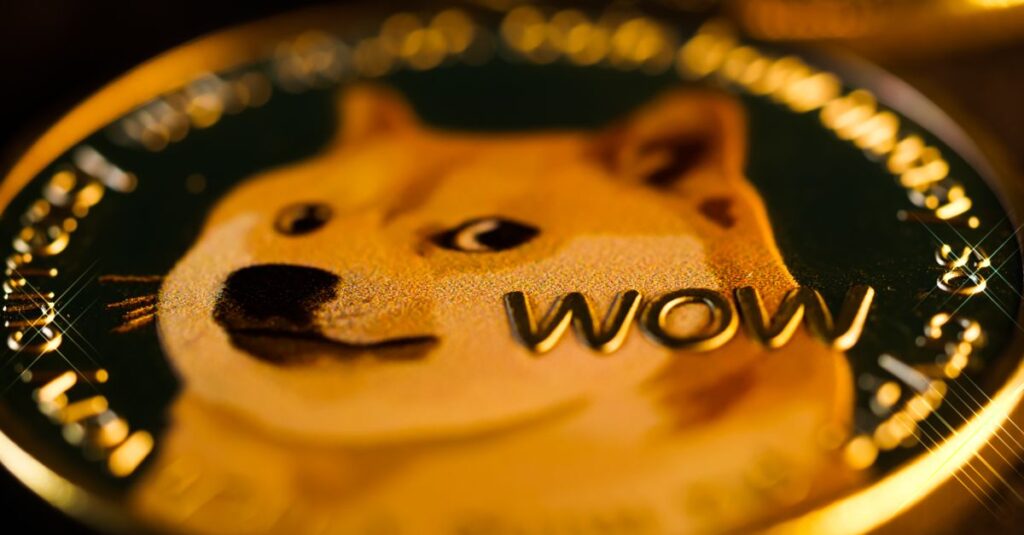
DogeOS, an Ethereum-compatible application layer for Dogecoin, opened its public testnet on September 30, letting developers build trading, lending and stablecoin applications that use DOGE for fees. The team behind the MyDoge wallet is betting that apps, not price speculation, give Dogecoin holders a reason to stick around.
The trial network runs on test DOGE and supports the familiar Ethereum tooling, so developers can port applications without learning a new stack. Projects building on it at launch include lending services, trading platforms and a cryptocurrency-backed stablecoin, according to documents the team shared with CoinDesk.
Why Dogecoin needs an app layer
DOGE is one of the largest cryptocurrencies, with a market value of about $13 billion, and most of it sits idle in wallets. The chain itself was built to do one thing: move DOGE between addresses. It cannot run a lending market or an exchange, and it has no smart contract layer.
DogeOS runs those applications on a separate system and lets users bring their DOGE across a bridge. That means trusting the bridge and the app layer to keep honest records, which is where the architecture gets contentious.
The first version relies on selected operators rather than Dogecoin’s miner network. A permissioned sequencer decides transaction ordering. Validators work alongside a trusted execution environment, a protected hardware section that checks proofs, and a committee called the Security Council oversees the system. Users of the early applications are effectively trusting that operator set, not Dogecoin’s proof-of-work network.
The long-term plan is to hand verification to Dogecoin’s own miners through a proposed Core upgrade called OP_CHECKZKP, which would add a rule letting Dogecoin nodes check zero-knowledge proofs computed elsewhere. The proposal was published in July 2025. A separate implementation submitted in December remains a draft, with a placeholder proof checker and further work required before any activation. Neither DogeOS’s mainnet nor the Dogecoin upgrade has a date.
“No other digital asset has Dogecoin’s combination of liquidity, community and cultural reach, and its potential has barely been tapped,” DogeOS founder Jordan Jefferson told CoinDesk. “A real economy built on Dogecoin is how we get there, and beyond.”
Jefferson was blunt about the motivation. Buying DOGE is easy, he said, but attracting institutional investors requires a stronger case for owning it. That case got weaker last month when Bitwise announced it would liquidate its Dogecoin ETF.
The ETF numbers are grim
The three US Dogecoin ETFs collected about $12 million in net inflows over nearly 10 months, according to CoinDesk’s analysis. That is less than XRP funds took in on September 9 alone. The funds recorded no net flows at all on 166 of their 199 trading days, and Bitwise’s fund held under $700,000 when it announced the closure. Final trading on NYSE Arca is expected October 14.
Market reaction to the testnet has been modest so far. DOGE traded near $0.093 to $0.10 in the days after the launch, and Coinbase prediction markets price a 68% probability that DOGE trades above $0.10 at some point in October. Whale wallets added roughly 1.14 billion DOGE near the $0.10 level, according to Gate News, though accumulation by large holders is a pattern that has preceded both rallies and exits in this asset’s history.
Not the first dawg
DogeOS is not the first attempt to put applications on Dogecoin. DogecoinVM, another team, is building toward a similar goal, and a succession of memecoin app chains, most famously Blast on Ethereum, have burned out. Blast, once home to $2.2 billion in deposits, announced this week that it would shut down after assets fell 98% and September chain revenue came to $1,793. Its users have until October 26 to withdraw.
The Blast failure is the cautionary version of the DogeOS pitch. Incentivized deposits and token incentives can fill an app chain with money that leaves as soon as the incentives stop. Whether an app layer on Dogecoin avoids that depends on whether applications attract organic usage from the coin’s actual holders, a group defined more by community attachment than by yield-seeking.
The architecture risk is real too. Blast was criticized for bridging assets to a multisig-controlled contract with no withdrawal path for a year. DogeOS’s Security Council and permissioned sequencer draw the same category of critique from decentralization advocates, and the mitigations OP_CHECKZKP promises are unshipped.
What to watch
Three markers will tell whether any of this matters. First, mainnet: no date means the testnet is a demo until proven otherwise. Second, the OP_CHECKZKP draft, which needs a working proof checker before Dogecoin’s developer community would consider activation. Third, testnet usage converting to real lending and trading volume on mainnet, which is the number the ETF flows never provided.
Dogecoin’s price history has always run on sentiment and celebrities. An application layer is an attempt to give the asset something more durable underneath. Other assets that tried it, from Avalanche ecosystem chains to memecoin L2s, have found that stories without usage deflate. DogeOS’s testnet is the first step, and the proof is still pending.
The deep irony is that Dogecoin’s simplicity is part of its brand. It works, it is cheap, and it transfers value. Adding a complex application layer risks diluting that identity, or it lays the groundwork for a genuinely useful economy around the coin. The testnet cannot answer that; mainnet and the OP_CHECKZKP path will.
DogeOS says developers can build on Dogecoin at last. Whether Dogecoin’s community wants what they build is now the question.