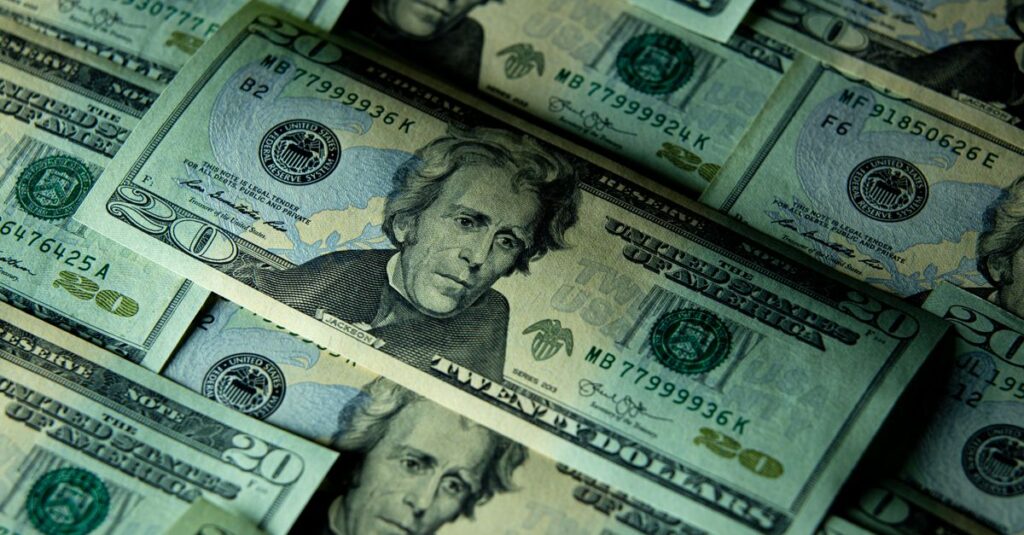
The US dollar’s share of global foreign exchange reserves fell to 56.7 percent in the second quarter of 2026, down from 57.18 percent in the first quarter, according to the IMF’s latest COFER dataset published on September 30.
Total world foreign exchange reserves rose slightly to $13.22 trillion from $13.10 trillion in the first quarter. Claims in dollars were largely unchanged in absolute terms, so the falling share came mostly from faster growth elsewhere. The euro led the gains, and the renminbi’s share climbed to 2.11 percent from 1.98 percent.
The pound sterling, Australian dollar and Swiss franc also picked up modestly, gaining 0.16, 0.13 and 0.03 percentage points respectively. The Canadian dollar and a basket of other currencies slipped slightly, although the other-currencies bucket still held above 6 percent of total foreign currency reserves.
| Currency | Q2 2026 share | Change vs Q1 |
|---|---|---|
| US dollar | 56.70% | -0.48 pp |
| Euro | rising | largest gain |
| Renminbi | 2.11% | +0.13 pp |
| Pound sterling | up | +0.16 pp |
| Australian dollar | up | +0.13 pp |
As the IMF’s data brief puts it, claims in dollars were largely unchanged in the quarter while euro and several other currency holdings increased. The dataset, known as COFER, covers central banks and other official reserve holders across more than 140 reporting economies, and it is the standard scorecard economists use to track the currency mix of the world’s official savings.
Valuation explains most of it
A separate IMF blog note published alongside the release argues the dollar’s share held steady when adjusted for exchange rate moves, with valuation effects driving nearly all of the decline. In other words, central banks did not dump dollars; the dollar weakened against the currencies their other reserves are denominated in, which shaved the dollar slice of the pie.
That distinction matters for anyone reading the quarter as de-dollarization. Central banks do adjust their mix at the margin: gold purchases have stayed heavy since 2022, and the share of currencies outside the major five keeps creeping up. In 2025 gold passed US Treasuries as a share of official reserves, a shift the IMF attributes almost entirely to price appreciation rather than active selling of Treasury bills.
The same pattern has repeated across recent quarters. When the dollar strengthens, its COFER share tends to rise mechanically; when it weakens, the share falls by roughly the same arithmetic. Underlying portfolio decisions move more slowly than the headline numbers suggest, and the IMF’s valuation-adjusted series has been far flatter than the raw one for most of the post-2015 period.
Why the trend still argues for slow erosion
The dollar share was about 71 percent in 2000 and has drifted lower through every subsequent decade. No single replacement has emerged. The euro’s role has grown only in small steps since its introduction, the renminbi remains capped by capital controls at barely 2 percent, and gold pays no yield, which limits how much of a reserve portfolio it can sensibly hold.
Sanctions risk has pushed some holders to diversify since 2022, when roughly $300 billion of Russian central bank assets were frozen. That episode is the main reason the non-major currency bucket has been climbing, and why bilateral settlement arrangements outside the dollar system have expanded, particularly among commodity exporters. China’s cross-border payment system and a growing web of local-currency swap lines give smaller central banks options that did not exist a decade ago.
The current quarter’s data fits the same slow pattern. The dollar remains the dominant reserve asset by a wide margin, used in more than half of trade invoicing and backed by the deepest and most liquid government bond market in the world. But the direction of travel continues, one basis point at a time, and the Q2 reading nudges the long decline forward a notch more.
What it means for markets
For bond markets, reserve flows are a steady, price-insensitive bid for Treasuries. A slower drift in that bid is one reason analysts watch COFER releases alongside foreign holdings data from the Treasury International Capital system. Yields have already been climbing this autumn for other reasons: the 10-year Treasury yield sits near 5.3 percent after the late September payrolls shock showed just 29,000 new jobs against forecasts near 90,000, and the 30-year yield is back at its highest levels since 2002.
For the euro, the quarter marks another increment in a longer campaign to widen the currency’s international role. ECB officials have repeatedly argued the euro’s share should rise with the EU’s capital markets union agenda and with a bigger supply of safe euro-denominated assets. The Q2 gains in euro holdings give that argument some ammunition, though the currency’s share remains far below the levels its architects projected when the common currency launched.
Emerging market central banks account for most of the recent drift. Their reserve pools have grown fastest, their appetite for gold has been strongest, and their exposure to sanctions risk is the highest. Shipments of gold to Asian vaults have hit repeated records since 2022, and several large EM holders, including China, no longer publish the full breakdown of their reserve composition, which makes the official data understatement more likely than overstatement.
The next COFER release, covering Q3, lands at the end of December. Exchange rate moves between July and September will shape the headline again, and the IMF’s valuation-adjusted view will show whether central banks added dollars in real terms or let the drift continue. Either way, the world’s savings are being held in the same currency mix as ever, plus a slowly widening sliver of everything else.