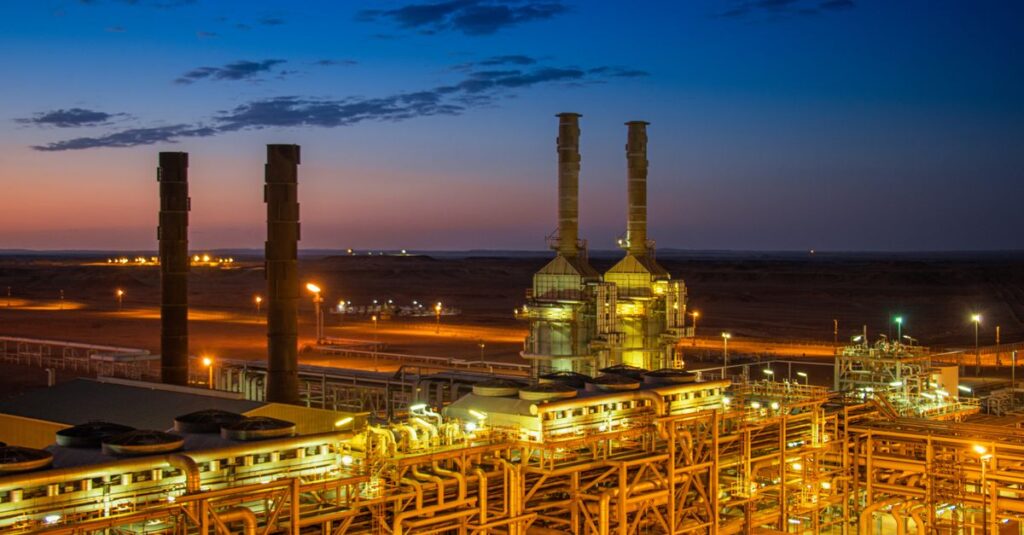
Riyadh. Yemen’s Houthis say they struck two Saudi Aramco facilities with ballistic missiles and drones on Sunday, one in the capital and one at the Khurais oil complex southeast of the city. The group claims both hits caused large fires. Saudi authorities have not confirmed damage, and Aramco has not issued any output figures.
Houthi military spokesperson Yahya Saree announced the operation in a video statement carried by Houthi-run al-Masirah TV and posted on X. He described two separate operations, the first against an Aramco facility in Riyadh and the second against the company’s oil facilities in Khurais. According to his account, both attacks achieved their objectives with precise hits that set off significant fires.
Saree said the strikes would continue until the attacks on Yemen stopped and what he described as a blockade on the country was lifted.
Saree framed the operation as retaliation for what the group called 50 Saudi-led coalition air and missile strikes on Sanaa and the provinces of Al-Jawf, Taiz, Amran, Hajjah and Saada over the previous 12 hours. He put the cumulative count of Saudi strikes since the escalation began at about 1,460, without saying when that period starts. Independent verification of either figure is not possible, since access to both the Saudi sites and Houthi-held Yemen is restricted.
Saudi offensive
The strike lands during a Saudi military campaign. Rashad al-Alimi, chairman of Yemen’s Presidential Leadership Council, announced in Riyadh on Sunday the start of a large-scale operation to retake remaining Houthi-held areas. That is the most explicit commitment yet to a ground phase in a war that had been frozen under a de facto ceasefire.
The Saudi-led coalition said it launched 97 targeting operations on the Tor al-Baha front on Sunday, using warplanes, drones, artillery, missiles and snipers. Saudi air defenses had earlier intercepted six ballistic missiles fired toward Taif and Yanbu, the kingdom said last week, without reporting damage to Aramco facilities at that stage. A separate Houthi claim of an attack on Yanbu facilities preceded those intercepts.
Al-Alimi’s announcement points to the largest Saudi intervention in Yemen since the coalition entered the war in 2015. Its stated goal is recapturing territory including Sanaa, which the Houthis have controlled since 2014. The group, aligned with Iran, spent two years attacking shipping in the Red Sea before the current round of direct exchanges with Riyadh.
Oil market
Khurais sits at the heart of Saudi Arabia’s eastern production cluster. The field processes about 1.5 million barrels per day at conventional capacity, according to Aramco’s own materials, and feeds the east-west pipeline system that moves crude to Red Sea export terminals.
Satellite imagery and geolocated video reviewed by AFP showed flames at a pumping station on that east-west pipeline network. Video from the Riyadh area showed smoke columns visible from the refinery site on the southern outskirts of the capital on Saturday, a day before the Houthi statement claimed the newest strikes.
The timing is awkward for a market already stretched. Physical dated Brent pushed above $120 a barrel this week as refiners face a diesel squeeze, China’s halt on fuel export quotas and Russia’s shipment ban. The G7 is coordinating a plan to release about 100 million barrels of emergency reserves, according to a Reuters report on Saturday.
Brokers say war-risk insurance rates for Gulf-bound crude tonnage rose again after the strikes, on top of the premium already charged for Red Sea transits. Freight desks in London and Singapore reported enquiries shifting from Gulf routes to longer-haul alternatives, a pattern that raises effective supply costs without cutting barrels immediately.
Response
Saudi state media stressed continuity of operations and made no output claim. The energy ministry said in a short statement carried by the official press agency that facilities were secured and that the kingdom reserves the right to respond at a time of its choosing. It gave no details of damage or production impact.
The United States called for restraint without announcing mediation. Secretary of State comments issued on Sunday urged both sides to avoid strikes on civilian and energy infrastructure, language that Washington used in previous rounds without effect. Oman and Qatar renewed standing offers to mediate, and an Omani official told local media that contacts were under way between the parties through intermediaries.
Iran’s foreign ministry, asked about the exchange, blamed Riyadh’s campaign and denied direct involvement, repeating its standard line that the Houthis act independently. The claim is treated with skepticism in Riyadh and Washington, which point to weapons supply and training links documented over years.
Markets in Asia opened Sunday evening with oil futures higher and Gulf equities lower. Traders said the premium now embedded in Brent reflects three overlapping risks: the Saudi-Houthi exchange, the Russian shipment ban and the Chinese export quota halt, any one of which could unwind quickly and take $10 or more off the price.
For the Yemeni population the escalation means more of the same and worse. United Nations agencies estimate that hundreds of thousands of people have been displaced in the fighting since September, on top of millions already displaced in a decade of war. Aid groups say ports under coalition control face inspection delays that slow food and fuel shipments.
The next signal is military, not diplomatic. If Riyadh proceeds with the ground phase al-Alimi announced, the campaign moves toward Houthi population centers and the tempo of missile and drone fire in both directions is likely to rise with it.