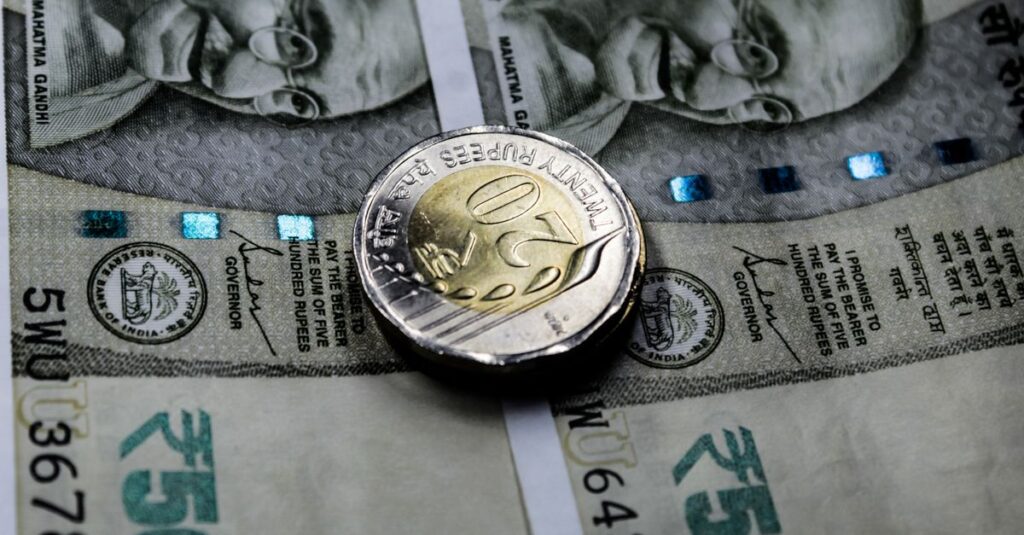
India’s central bank announced emergency measures Saturday to defend the rupee after it slid within striking distance of its record low, opening a special dollar window for the country’s three state-owned oil refiners and clamping down hard on currency derivatives trading.
The Reserve Bank of India will let Indian Oil, Hindustan Petroleum and Bharat Petroleum draw dollars directly from its foreign exchange reserves starting Monday through a dedicated window that covers their daily dollar requirements. The three government oil-marketing companies are among the largest sources of dollar demand in the spot market, and pulling their buying out of it removes a persistent, predictable source of pressure on the currency.
The measures land on a market already bruised by weeks of outflows. Foreign investors have pulled money from Indian equities through the autumn, adding dollar demand on top of the oil bill, and the central bank’s earlier interventions had slowed but not stopped the slide. Friday’s close at 96.73 came after dealers reported heavy state-bank selling of dollars through the session, the usual signature of RBI ops in the spot market.
The rupee closed Friday at 96.73 per dollar, barely changed on the day, but close to its all-time weakest level of 96.96 hit in May. In the non-deliverable forward market Saturday, the one-month dollar/rupee contract fell about 40 paise in very thin trading after the announcement, an early sign the measures found buyers offshore as well as onshore.
What the RBI actually did
The package goes well beyond the oil window. Foreign exchange dealers may not permit users to rebook derivatives contracts, a rule aimed at traders who roll and reposition hedges to profit from volatility. The central bank cut the limit on positions in exchange-traded rupee derivatives to $5 million from $100 million, a 95 percent reduction that effectively shuts out most professional positioning. Dealers must also maintain a foreign exchange risk reserve equal to 20 percent of the notional amount of every derivatives contract involving the rupee, raising the cost of carrying such positions at all.
ANZ strategist Dhiraj Nim told Reuters that removing the oil companies’ dollar requirements strips one of the largest sources of spot-market demand, which should reduce volatility, but the dollars come from reserves, so the support shows up as reserve depletion rather than painless stabilization.
The central bank has already sold dollars from its reserves and delivered policy rate increases, and the pressure has persisted anyway. The reason sits in the import bill: Brent crude has held above $104 since the Iran war pushed tankers out of normal patterns and the Strait of Hormuz became a chokepoint. India buys most of its oil abroad, so every dollar of Brent is a rupee-selling event somewhere in the system.
The choice of the oil companies is deliberate. They import crude on behalf of the state and buy dollars every single day regardless of the exchange rate, so their demand is the most predictable block in the market. Supplying them from reserves costs the RBI nothing in market impact, whereas their absence from the spot market removes a daily flow that traders could lean against.
A playbook with history
Direct dollar supply to oil companies is a mechanism the RBI has used in past currency stresses, most recently in 2022 when the rupee also traded near record lows. The idea is simple: a large, predictable block of daily demand leaves the visible market and lands on the central bank’s balance sheet, where timing matters less and signaling is quieter.
The derivatives clampdown is the more contentious half. Traders argue that gutting the exchange-traded derivatives market reduces hedging capacity for genuine importers and exporters, which can backfire by leaving real commerce unhedged while speculators simply move offshore. The RBI has clearly judged, as it has before, that speculation is driving more of the weakness than trade flows, and that the reputational cost of the rupee approaching 100 outweighs the convenience of a deep derivatives market.
There is also a political dimension. A rupee near record weakness feeds imported inflation just as oil prices strain household budgets, and the government cannot want that story running into any period of economic stress. The RBI’s willingness to burn reserves and restrict markets at the same time signals that officials see the level itself as the problem, not just the volatility.
Reserve levels give the RBI room to run this strategy for months, but not indefinitely, and every strategist in Mumbai is now watching the weekly reserve print as the gauge of how hard the bank is working. Spending reserves to defend a level is a policy with an expiry date, and the bank knows the market knows it.
Whether the defense holds depends on two variables outside Mumbai: the path of the Iran conflict and whether Brent stays above $100. A ceasefire would ease oil and ease the rupee simultaneously. If crude keeps climbing, the import bill grows and the defense gets more expensive. If the measures work, the mechanics will look dull from outside: the rupee drifts back to 95-ish, volatility falls, and the derivatives market rebuilds its volume in smaller clips. If they fail, the RBI faces the choice every emerging-market central bank dreads, between spending more reserves, tightening policy into a fragile economy, or letting the currency find a weaker level. None of those options is attractive, which is why the dollar window and the derivatives clampdown arrived together, on a Saturday, before the Monday session could test the 96.96 mark in an uncontrolled way.
For now the central bank has drawn its line well above the psychological 97 level, and Monday’s session, the first with oil companies out of the spot market, will be the first real test of whether the wall stands.