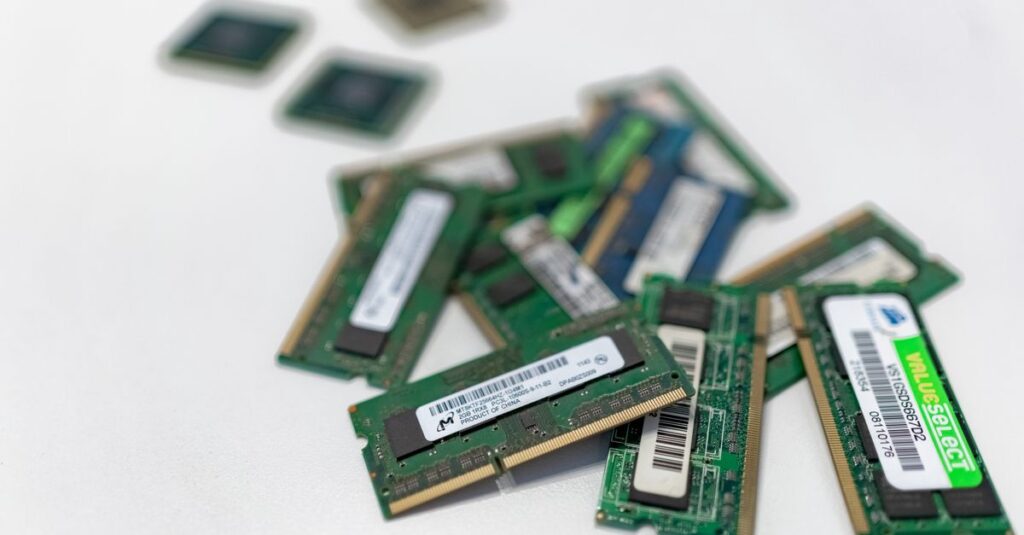
Micron expects the memory shortage gripping the industry since late 2025 to get worse before it gets better, with supply-demand conditions “much tighter” in 2027 and 2028 than they were this year, CEO Sanjay Mehrotra said on the company’s fiscal fourth-quarter earnings call.
Micron held that call on September 30, and the comments have rippled through coverage all week, reported by Ars Technica, The Register, Computerworld and PCMag, among others. Mehrotra also said he has no visibility into when supply and demand return to balance.
That is a darker outlook than the one most industry forecasts carried earlier in the year, which had supply and demand normalizing around 2028. It now reads as the point at which the market starts to unwind, not the point at which it ends.
Where the shortage came from
The proximate cause is high-bandwidth memory, the stacked DRAM that sits next to AI accelerators from Nvidia and AMD. HBM is made on the same fab lines as ordinary DRAM, but it yields more revenue per wafer, so memory makers have shifted capacity toward it. That leaves less conventional DRAM for servers, PCs and phones, and the price signals have been loud.
DDR5 prices climbed more than 100% during 2026. Micron’s CFO, Mark Murphy, said the company’s DRAM prices rose by a percentage in the high teens in the fiscal fourth quarter alone, while NAND prices climbed about 30%. JPMorgan Global Research estimates DRAM prices will have risen more than 400% from the start of 2024 to the end of 2026. Consumer prices are following. JPMorgan points to the CPI for software and accessories and the PPI for storage devices, both up 23% since the end of 2024.
| Indicator | Move | Source |
|---|---|---|
| DRAM prices, 2024 start to 2026 end | up more than 400% | JPMorgan Global Research |
| DDR5 retail prices during 2026 | up more than 100% | market pricing data |
| Micron DRAM prices, fiscal Q4 | up high-teens percent | Micron CFO Mark Murphy |
| Micron NAND prices, fiscal Q4 | up about 30% | Micron CFO Mark Murphy |
| US CPI software and accessories, since end 2024 | up 23% | JPMorgan, citing BLS |
| Micron fiscal 2027 output already committed | over 75% | Micron earnings call |
Sold out through next year
Micron’s own numbers put the squeeze in terms a buyer can use. More than 75% of the company’s planned fiscal 2027 output is already committed, and most customer discussions have shifted to 2028 volumes. On the AI side specifically, Mehrotra noted that Micron’s HBM pricing for 2027 was negotiated with customers last year.
“For 2027, a large part of the volume is already sold out for HBM, and the prices are much higher than 2026 prices.”
Sanjay Mehrotra, Micron CEO, on the September 30 earnings call
Bit shipments are still growing. Micron expects industry DRAM bit shipments to rise in the low-20% range in 2027 and 2028, and NAND in the mid-20% range. But the company expects both markets to stay supply constrained through that period anyway, which is the arithmetic of a shortage driven by demand outrunning capacity additions.
The HBM pricing story has a wrinkle worth keeping straight. TrendForce, the market tracker, revised its 2027 blended HBM price outlook upward in late September and sees average selling prices rising 121% year over year. That means the contract prices Micron locked in last year, the “much higher” ones Mehrotra mentions, are already on the books, and the spot market is running ahead of them.
Who feels it
PC makers are the most exposed consumer story. TrendForce’s September bulletin noted that OEM price hikes have already curbed notebook output, with PC and mobile brands cutting production and hunting for alternative memory sources. Smartphone brands, it noted, are piloting alternative memory chips and exiting low-margin product lines. Lenovo’s CEO, Yuanqing Yang, said the company expects memory demand to keep rising and supply to stay constrained at least through the end of 2027, and that Lenovo passes component costs through “in a timely manner.”
Data center operators face the same math with bigger invoices, since AI clusters consume memory at a scale consumer devices never see. Buyers who planned hardware refreshes in 2027 are now looking at elevated prices and tighter configuration choices for two more years at least.
Micron itself pulled its Crucial consumer RAM brand from the retail market, announced in December 2025, which is the clearest sign available of where the company wants its wafers to go. Consumer RAM buyers can still find third-party modules, but the shelf is thinner than it was.
The shortage also bleeds into other markets in ways that are easy to miss. JPMorgan’s analysts warn that a major cyberattack on US infrastructure would unleash an estimated $145 billion in additional chip demand on a market already at capacity, a scenario in which demand “could not be met within six to 12 months.”
There is a geopolitical layer too. A TrendForce report published Monday notes that AI and HBM demand are pulling memory testing equipment into a shortage of its own, with Advantest and Teradyne dominating and Chinese suppliers starting to challenge what has been an 80%-import market.
What changes the picture
Capacity additions could still soften the squeeze, and Micron’s forecast is a company’s view, not a market consensus. New fabs take years to build and equip, and memory makers are still prioritizing HBM conversion. Demand could also crack if AI spending cools, though nothing in the current order book suggests it will. Murphy’s comment that Micron’s “inventory levels and supply remain extremely tight” is the shortest summary of where things stand.
For buyers, the practical answer is the one Micron’s outlook forces: plan hardware refreshes around the cost of memory you can actually get, not the cost you remember.