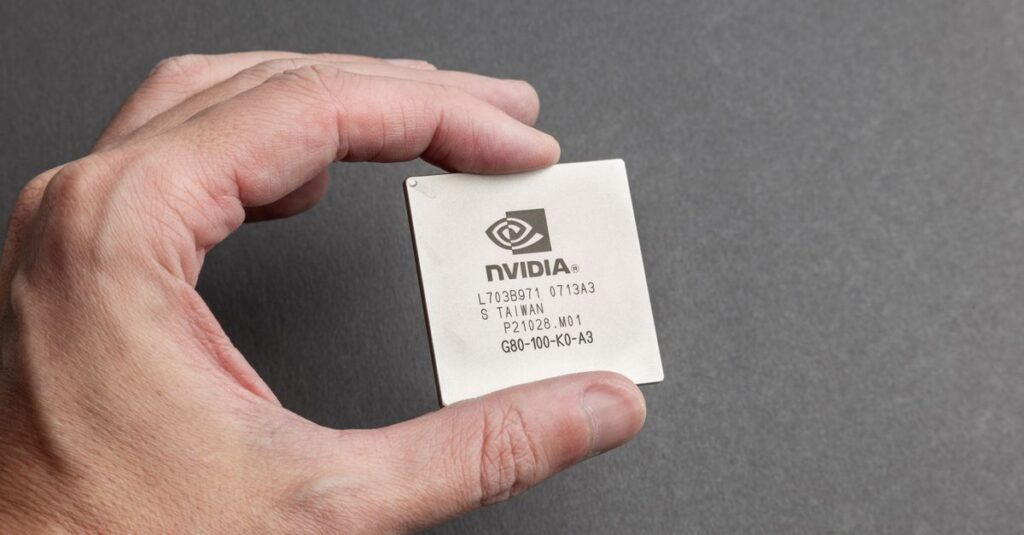
Nvidia has more than halved the number of Asian customers authorized to buy its AI chips, creating a white list of companies that pass tougher compliance checks, according to reports by the Financial Times and Tom’s Hardware. The chipmaker has also started sending field inspectors to customer data centers and calling clients directly to verify that their business is genuine.
The tightening follows sustained pressure from Washington, where the Commerce Department issued guidance in May aimed at stopping advanced AI chips from reaching overseas subsidiaries of Chinese companies. The concern is specific: cutting-edge Blackwell processors appearing in Chinese-linked entities in countries like Malaysia and Singapore despite US export restrictions.
How the checks work
Nvidia’s due diligence has intensified across Singapore, Malaysia and Japan, the FT reported, citing three people familiar with the matter. Staff now visit customers’ data centers in person, verify contracts and interview end users as part of the checks. The white list approach means companies outside it cannot buy at all, a shift from the older model where any qualified buyer could order.
The scale of the problem explains the paranoia. Taiwanese prosecutors have indicted a senior Nvidia manager, named only as Chang, along with eight others, for allegedly organizing the shipment of 74 servers containing high-end B300 chips into China via Japan and Indonesia. Another 56 servers were seized before they left. Federal authorities in the US have separately arrested men charged with smuggling Nvidia GPUs, and one seizure reportedly included ten HPE supercomputers loaded with H100s and fifty H200s.
Singapore has its own case: four firms charged over false representations, with about $56 million in assets seized. Investigators there probed whether servers bought legitimately in Singapore were being moved onward to China, after Nvidia itself flagged that a share of its Singapore-billed revenue had no matching local end users. In one Taiwanese case, prosecutors put the value of hardware smuggled into China at $2.5 billion, a figure that dwarfs most financial fraud prosecutions in the region.
The diversion playbook
The methods keep evolving. One documented pattern involves Chinese firms securing non-Chinese-owned data centers in Southeast Asia, buying chips through authorized distributors, passing inspections, then dismantling the servers and smuggling the components into China through false customs declarations before reassembling them at domestic data centers. Another involves companies like Megaspeed, founded in 2023 and rapidly one of the biggest Nvidia buyers in Southeast Asia, allegedly leasing GPU capacity from regional data centers to Chinese customers including Alibaba, so the silicon never physically crosses a border while the compute still serves China.
Each workaround has pushed enforcement in a different direction. Physical smuggling produced server inspections at ports. Cloud-style diversion pushed the Commerce Department toward ownership-structure analysis, which is why BIS said it would closely examine Megaspeed’s corporate structure and trace whether chips physically moved. The pattern across all of it is that enforcement closes one door and the trade opens another, which is precisely why Nvidia has moved from paperwork checks to boots on the ground.
What it costs Nvidia
Cutting the customer list is expensive. Southeast Asian data center demand is legitimate and growing, and every authorized buyer removed is revenue handed to whatever gray market fills the gap. Nvidia’s compliance staff, once a modest function, now runs what amounts to a field investigation operation across three countries.
The company has little choice. Failing to police diversion invites tighter export rules on its entire product line, and Washington has already shown willingness to restrict sales outright. The inspector model, intrusive as it is, keeps legitimate Asian business flowing while giving Nvidia documentation it can show regulators.
There is also a competitive angle Nvidia rarely states publicly: every enforcement gap Huawei can exploit is a customer Huawei gains. DeepSeek’s latest model was trained in part on Huawei Ascend hardware, a development Nvidia’s chief executive once called a horrible outcome for the United States. Every smuggled Blackwell that reaches a Chinese data center is an argument for Chinese chips becoming good enough not to need smuggling. That dynamic puts Nvidia in the strange position of arguing for stricter enforcement of rules that, if they fail, accelerate the rise of its only serious competitor.
The wider picture
The enforcement escalation runs alongside the policy debate about whether controls work at all. Estimates of smuggled hardware run into billions of dollars, and prosecutions keep surfacing new channels: individual employees inside Nvidia itself, regional distributors, cloud intermediaries. Controls have clearly raised the cost and risk of diversion, and just as clearly not stopped it.
For data center operators in Singapore and Malaysia, the new regime means longer sales cycles and inspections that treat every buyer as a potential smuggler. For the industry overall, it is another sign that AI compute has become a strategic controlled good, policed with methods closer to arms export enforcement than to enterprise IT sales. The customers passing white list checks today will find the relationship more surveilled than any enterprise hardware purchase they have known, and the ones cut from the list will either exit the market or find someone willing to sell to them anyway.
The deeper question for Washington is whether the inspection model scales. Nvidia is a private company doing what it can, but customs authorities, not chip vendors, are the institutions built for this. If the smuggling trade keeps adapting faster than compliance teams can, the pressure will shift back toward blunt instruments: outright sales bans, which punish every legitimate buyer in Asia for a crime committed by a fraction of them, or negotiated licenses, which reopen the door the controls were built to close. Neither option is appealing, and the current white list regime is best understood as the attempt to avoid choosing between them.