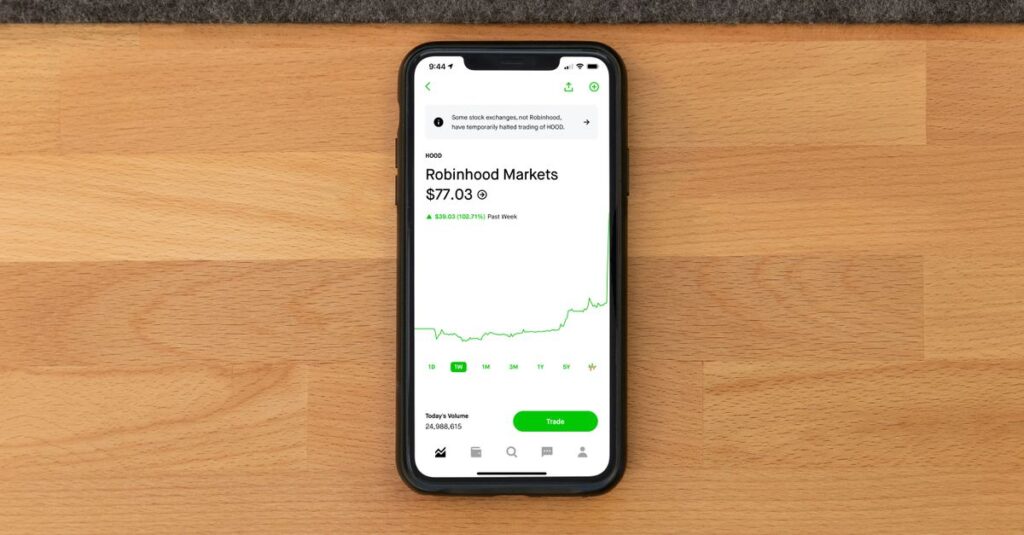
Robinhood Chain has become the fastest-growing fee generator in crypto barely two months after launch. The Ethereum layer-2, built on Arbitrum’s technology stack and opened to the public on July 1, has logged daily fee records all week, and a 10% revenue share is now sending real money back to the Arbitrum ecosystem, a flow traders have started to price into the ARB token.
The numbers moved fast. On Sept. 1 the chain generated a record $3.75 million in daily fees, its fourth consecutive all-time high, making it the highest fee-generating blockchain network that day, according to DeFiLlama. Two days later it cleared $4.45 million in fees and kept $4.01 million as revenue. By Sept. 5 it hit $6.12 million in a single day, with the seven-day annualized fee run rate reaching $1.1 billion. For comparison, the Arbitrum network itself generated less than $15,000 in fees on the same day Robinhood Chain posted its $3.75 million record.
The trajectory is steeper than the levels. Six days before the $4.45 million day, chain fees stood at $200,211 and revenue at $179,815, roughly a 22-fold increase in under a week. Weekly DEX volume on the chain reached $6.92 billion at one point, up 89% week over week. Whatever else is true about the project, the fee curve does not look like a slow institutional ramp.
Where the money goes
Under the Arbitrum Expansion Program, chains built with the Arbitrum stack that settle to a parent chain other than Arbitrum One pay 10% of net protocol revenue back to the ecosystem. That splits 8% to the Arbitrum DAO treasury and 2% to a developer guild. On the Sept. 1 record day, the arrangement delivered roughly $370,000 to Arbitrum. In its first month alone, Robinhood Chain contributed $360,000 in licensing fees, about 35% of the DAO’s revenue that month.
Robinhood keeps most of the pie. Around 89% of gross fees stay with the company, with roughly 10% going to Arbitrum and under 1% to Ethereum for data availability. CFO Shiv Verma told analysts on the Q2 call that the company earns a few basis points per transaction, without disclosing a rate or a reconciliation. ARK Invest analyst Lorenzo Valente drew the distinction that matters for token holders: “Ethereum’s cut is a fixed-ish L1 data-posting cost, not a revenue share. Arbitrum’s cut is a true percentage-of-revenue license. So on a spike day, Arbitrum scales up with REV but Ethereum barely moves in dollar terms.”
Memecoins built the machine
Here is the awkward part: the chain built to host tokenized stocks is currently running on speculation. Launchpad platforms Pons and GMGN have turned it into a memecoin venue, with peak days seeing more than 22,600 new token launches, roughly one every four seconds. GMGN took $1.23 million in revenue over 24 hours and Pons $948,044, both ahead of Uniswap at $445,379. Cumulative DEX volume passed $47 billion within two months.
The tokenized equity business is real but small so far. Robinhood Chain has launched 194 U.S. stock tokens with a total issuance market cap of about $158 million, operating under a unified base prospectus approved by Liechtenstein’s FMA. The RWA active market cap on the chain sits in the low hundreds of millions. Memecoins paired with tokenized shares account for roughly a quarter of share-linked trading volume, a hybrid that has produced oddities like Artificial Inu, a token paired with tokenized Nvidia stock whose market cap surged from $1.5 million to $135 million in August.
DeFi metrics have climbed alongside. TVL peaked around $1.4 billion with nearly 200 dApps deployed, led by Morpho Blue, Steakhouse Financial, Uniswap and Lighter. Stablecoin supply crossed $900 million, and the chain has processed daily DEX volumes above $1.4 billion. Robinhood also ran a 90-day gas subsidy from launch, cutting the gas sponsorship threshold in its Wallet from $5 to $0.50. That program ends Sept. 29, which makes the next few weeks a live test of whether demand survives without the free rides.
ARB catches the bid
Traders noticed. ARB jumped 30% in 24 hours to around 11 cents on the fee news, breaking out of the 7-to-10 cent range that had contained it since June, on $618 million in volume, an eightfold increase over the prior day. By early September it had pushed past 20 cents, up nearly 200% from its yearly low, with market cap around $1.2 billion. Order books thickened alongside the price move.
Whether the repricing is proportionate is a fair question. The incoming revenue flows to the DAO treasury and developer guild, not to token holders directly, so the rally is largely a bet on correlated momentum. “Even if it’s not directly tied to revenues, we’ve seen this dynamic a few times where the beta eventually plays catch up,” said Myher, an analyst cited by CoinDesk. Bernstein analysts project Robinhood Chain could generate $160 million in annual fees by 2028, driven by tokenized stock trading, and FalconX previously estimated up to $60 million annually by 2030. Against those forecasts, the chain’s $13 million in fees over its first two months is an early installment, not a completed story.
The context matters too. Arbitrum’s own fundamentals had weakened through the crypto winter, with TVL down to $1.25 billion from $3.7 billion at its peak and chain fees of just $1.2 million last quarter. Robinhood Chain is now the brightest line item in the ecosystem’s economics, and the DAO that governs ARB has a growing income stream it did not have in July. Analysts also flagged that ARB’s rally ran into overbought territory, with the RSI near 84 and a shooting-star candle on the daily chart, a setup that often precedes a pullback toward prior resistance.
The risks are straightforward. Daily fees alone do not prove durable adoption, the subsidy cliff arrives in late September, and the memecoin mix could fade as fast as it arrived. An unlock window also looms for the token. But for the first time, ARB has a concrete, measurable revenue attachment to one of the largest retail brokerages in the United States, and the market has started paying for it. The next few weeks, post-subsidy, will show whether the fees were demand or discount.