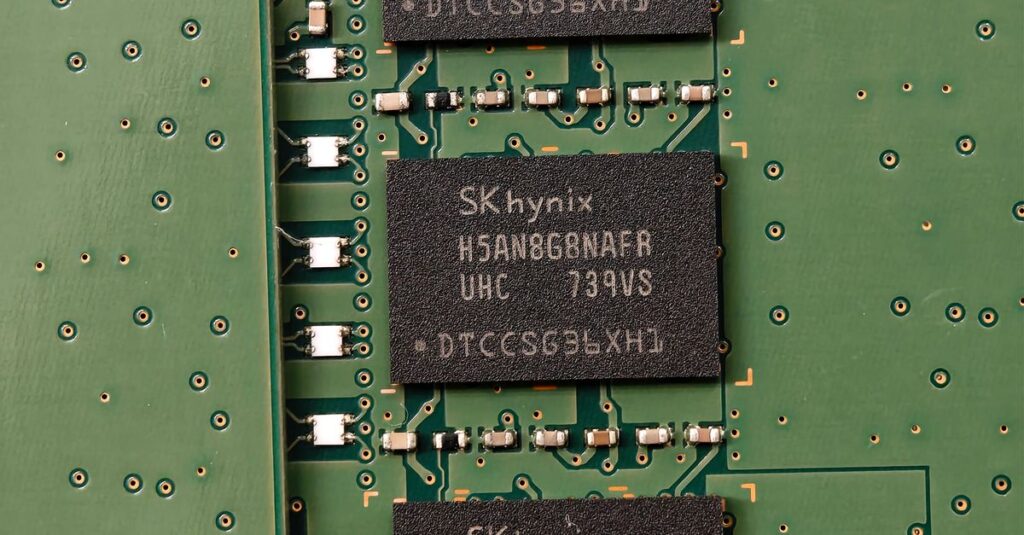
SK hynix is in exploratory talks with Intel to manufacture memory chips in the United States for the first time, possibly at Intel’s stalled Ohio fab site, Reuters reported on Tuesday, citing three sources familiar with the matter. The talks are early and no agreement exists, but a deal would mark the first time the South Korean memory giant produces chips on US soil.
Two main options are under discussion, according to the sources. SK hynix could lease part of Intel’s Ohio site, or the companies could form a joint venture that also includes major technology companies, reportedly cloud providers looking to secure memory supply. It has not been decided whether the products would be high-bandwidth memory, conventional DRAM or NAND flash, and one person briefed on the talks cautioned that a final agreement is far from certain.
SK hynix said in a statement that it is reviewing various options to strengthen its competitiveness but that nothing has been finalized.
Why both companies need it
The logic runs in both directions. Intel began building the Ohio One site in New Albany with production originally planned for 2025, but completion has slipped repeatedly and now sits at 2030 or 2031. CEO Lip-Bu Tan slowed construction further after taking over in 2025, saying the company had invested too much too soon. Intel had sunk more than $5 billion into the site by the end of last year, closer to $7 billion including contract commitments, against a total campus cost estimated at $28 billion.
A tenant with a credible memory business would ease Intel’s financial burden on a facility it has already poured billions into, and would give Intel’s foundry pitch its most concrete external customer yet. New Albany’s mayor, Sloan Spalding, told local public radio in August that Intel has been transparent about needing customers lined up to keep the project moving at a good pace, though he acknowledged there had been slowdowns before things picked up again.
For SK hynix, US production would ease political pressure. The US government has been pushing for domestic memory manufacturing, and global demand for HBM and advanced DRAM is running at record levels, driven by AI data center buildouts. SK hynix supplies HBM to Nvidia and leads that segment, but its production sits in South Korea, with packaging operations in other countries. A US fab would also insulate the company from tariffs or restrictions that could theoretically target foreign-made memory, a concern that has grown as Washington scrutinizes semiconductor supply chains.
The Seoul export-control hurdle
Any deal faces a regulatory obstacle at home. HBM and advanced DRAM manufacturing technologies are designated as South Korean national core technologies, so any overseas expansion requires government review under the country’s Act on Prevention of Divulgence and Protection of Industrial Technology. Seoul has previously constrained overseas fab plans involving sensitive process technology, and a review of a US memory fab would be the first of its kind at this scale.
Korean media coverage of the Reuters report noted that cost concerns and technology-leak worries pose obstacles, and that the government review is itself a variable that could reshape or kill the deal. The products to be made, including whether HBM would be produced in Ohio at all, remain undecided. That distinction matters: HBM is where the margins and the strategic value sit, and it is also the technology Seoul guards most closely.
Context: the AI memory squeeze
The talks come amid a broader scramble for memory capacity. HBM is sold out years in advance, and conventional DRAM pricing has firmed as suppliers shift wafer capacity toward AI-grade memory. Cloud providers, who would reportedly join the possible joint venture, have been trying to lock in supply directly rather than depend solely on markets where they compete with every other AI buyer. Rivals have moved the same way: Samsung has backed new chip ventures, and Micron has announced US expansion plans of its own, though none of these approaches a full foreign HBM line on US soil.
| Item | Detail |
|---|---|
| Ohio One campus cost | About $28 billion, announced January 2022 |
| Original opening target | 2025 |
| Current target | First fab complete by 2030-2031 |
| Spent by end of 2025 | Over $5 billion, about $7 billion with commitments |
| Options under discussion | Lease of part of the site, or a joint venture with cloud companies |
| Open questions | HBM vs DRAM vs NAND, Korean government review |
Intel, meanwhile, has been reshaping its manufacturing strategy, opening its foundry business to external customers and seeking partners to share fab construction costs. The Ohio site was pitched at its 2022 groundbreaking, attended by President Biden, as part of a US push to rebuild domestic chipmaking. It was billed as Intel’s first new manufacturing site in four decades, and the region has been waiting on the promised jobs ever since.
Neither company has committed to anything. The sources emphasized that the discussions could end without a deal, and the South Korean review process would take months even if commercial terms were settled quickly. A lease arrangement would be the simpler path, since it avoids the governance questions of a joint venture, but it would still require Seoul to accept that its core technology would operate inside an American facility.
For the Ohio region, a memory tenant would be the strongest sign yet that the site will actually open. The alternative, a fab that never finds a customer, has become a real possibility the longer construction drifts, and both companies have reasons to prefer a deal to that outcome.