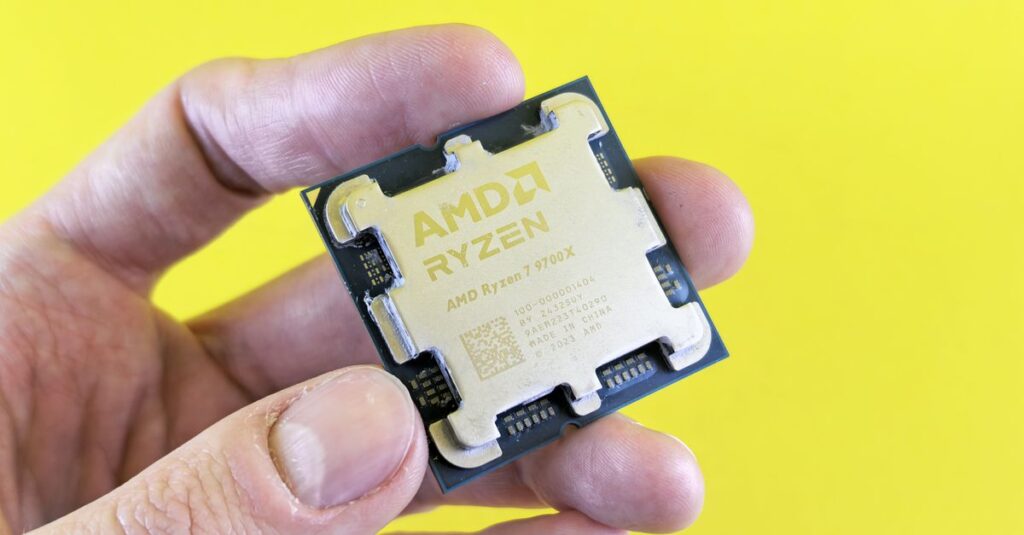
Advanced Micro Devices crossed $1 trillion in market capitalization for the first time on Monday, becoming the latest chipmaker to reach a milestone that only a handful of companies have managed.
AMD shares hit an intraday record of $615.52, lifting the company’s value just above $1 trillion during the session. The stock rose close to 10 percent on the day, extending a five-day winning streak that has added roughly 25 percent. At the start of 2026 the shares traded near $215, so the move marks a gain of more than 180 percent year to date. A year ago AMD was a $215 stock that investors treated as a secondary player in the AI buildout.
Reuters reported the milestone puts AMD in a small group of chipmakers that have reached a trillion-dollar valuation, joining Nvidia, which got there in 2023, and memory makers SK Hynix and Micron, which both crossed the line earlier this year. Nvidia’s market cap stands at about $5.4 trillion, so AMD remains a distant second in the accelerator market it is chasing, but the gap has narrowed faster this year than almost anyone forecast in January.
The AI ramp behind the rally
The run has been driven by AMD’s data center business. In the second quarter the segment posted $6.72 billion in revenue, up 107 percent year over year, and now makes up 58 percent of the company’s total sales. Management guided third-quarter revenue to roughly $13 billion, an increase of about 41 percent year over year. Those are not projections of what the AI business might become. They are bookings that have already landed.
The product investors are pricing in is Helios, AMD’s rack-scale AI platform that combines MI400 and MI450 series GPUs, sixth-generation EPYC Venice CPUs, and the company’s Pensando networking stack into integrated systems for training and running large AI models. CEO Lisa Su has described customer demand for Helios as very strong and tracking ahead of initial forecasts.
The customer list does the heavy lifting in the bull case. Anthropic has committed to up to 2 gigawatts of MI450 GPUs in Helios racks, Meta has gigawatt-scale Instinct GPU deals in place, and OpenAI and Microsoft Azure have both expanded Helios collaborations. At the company’s Advancing AI event this month, AMD unveiled the Instinct MI450 Series GPUs and Venice CPUs alongside the Helios rack platform, which analysts read as a direct challenge to Nvidia’s grip on AI data center spending. AMD’s pitch is that a full-rack system, delivered as one product with GPUs, CPUs, networking and software tuned together, shortens deployment time for customers building large clusters compared with assembling components from separate vendors.
| AMD data points | Figure |
|---|---|
| Intraday record price | $615.52 |
| Market cap milestone | $1 trillion, first time |
| 5-day stock gain | About 25 percent |
| Year-to-date gain | Roughly 180 percent |
| Q2 data center revenue | $6.72 billion, up 107 percent |
| Q3 revenue guidance | About $13 billion, up 41 percent |
From summer dip to record run
The path here was not straight. AMD fell in late July and early August after second-quarter earnings, even though the results beat expectations. Su told analysts on the earnings call that the company expected a softer PC market in the back half of 2026, and the guidance weighed on shares tied to consumer demand. Investors who bought the dip in August have more than doubled their money in six weeks.
The AI business overrode that concern. As hyperscalers committed spending to AI infrastructure through the summer, investors rotated back into the chip supply chain, and AMD’s OpenAI deal, signed in October 2025, gave the company a marquee customer for its accelerator roadmap. The stock has not looked back since early August, and the five-day streak that produced the trillion-dollar cap is the latest leg of that move.
The broader chip rally has lifted the whole sector. Nvidia remains the anchor of AI infrastructure spending, but investors have been spreading bets across the supply chain, from memory makers to networking equipment suppliers, as data center construction shows no sign of slowing. SK Hynix and Micron both reached trillion-dollar valuations this year on memory demand driven by the same buildout. AMD’s milestone is the latest confirmation that markets see the AI buildout as a multi-year story rather than a one-quarter spike.
What comes next
AMD still has to prove the MI450 ramp converts to revenue at the pace the valuation implies. The company reports third-quarter results in early November, and the roughly $13 billion guidance will be the first test of whether Helios shipments are landing on schedule. Any slip in the gigawatt-scale deals with Anthropic, Meta or OpenAI would hit the stock harder at these levels than it would have a year ago, because the premium now embedded in the price assumes execution.
Competition is also tightening. Nvidia’s next-generation Rubin platform is expected to keep pressure on AMD’s accelerator lineup, and custom silicon programs at Google, Amazon and Microsoft reduce the addressable market for merchant GPUs. Each hyperscaler designing its own training chips is a customer AMD cannot win with off-the-shelf parts. The company’s counterargument is that not every workload justifies a custom program, and that Helios gives mid-sized AI builders a faster path to capacity than waiting for bespoke silicon.
Power and supply constraints add another variable. Gigawatt-scale GPU deployments depend on grid connections and transformer availability that have become bottlenecks across the industry, and any slowdown in data center construction would show up in accelerator orders within a quarter or two.
For now, the market has voted. AMD joins Nvidia, SK Hynix and Micron in the trillion-dollar chip club, and the stock’s 180 percent run makes it one of the defining tech trades of 2026. The question for the next twelve months is whether the AI spending wave that carried it there keeps rising, or whether AMD’s milestone marks the point where expectations finally outran the order book.