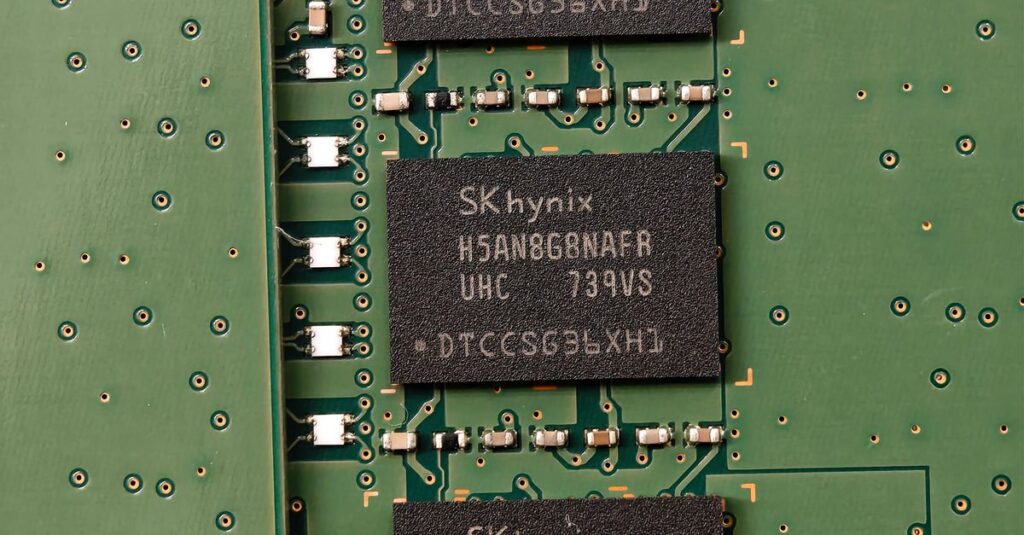
SK Hynix is in exploratory talks with Intel about a deal that would see the South Korean memory giant manufacture chips in the United States for the first time, Reuters reported on September 16, citing three people familiar with the discussions. The news sent both stocks higher: Intel closed up 4% at $101.05, and SK Hynix’s Nasdaq-listed shares rose about 2% in premarket trading.
Under one scenario being discussed, SK Hynix would lease part of Intel’s long-planned chipmaking facility in Ohio. Under another, the two companies would form a joint venture with major cloud firms that want to secure memory supply. One source described the talks as exploratory and stressed that no decisions have been made, and Reuters could not learn what types of chips SK Hynix might produce in Ohio if a deal is struck. The company might also consider other ways to structure the arrangement entirely.
SK Hynix moved quickly to downplay the report. In a statement on its newsroom page framed as a fact-check, the company said it is exploring various options to strengthen global competitiveness but that no specific plans, agreements or decisions have been finalized regarding the two scenarios described in the article. Intel did not respond to CNBC’s request for comment on the report.
Why it matters for Intel
A deal would be a significant win for Intel, which has spent billions trying to attract marquee customers for its foundry business, the central pillar of CEO Lip-Bu Tan’s turnaround strategy. Signing one of the world’s two leading memory makers as a foundry customer would validate Intel’s Ohio investment and give the fab a tenant with proven demand rather than a speculative one. Memory manufacturing has historically been concentrated almost entirely in South Korea, Japan and Taiwan, so a US-based memory line would be a genuine first for the industry, not a marketing claim.
It would also serve Washington’s agenda. The US government has been pressing chipmakers to build on American soil amid an acute shortage of memory chips driven by AI data center demand. SK Hynix is the leading supplier of high-bandwidth memory, the component stacked beside Nvidia’s accelerators, and every AI system sold depends on it. Bringing even part of that supply chain to Ohio would reduce a dependency that US policymakers have flagged repeatedly, and it would fit the pattern of the administration extracting manufacturing commitments from foreign semiconductor firms through a mix of incentives and pressure.
Analysts added to the momentum on the Intel side. Melius Research reiterated its Buy rating with a $165 price target, and analyst Ben Reitzes suggested the stock could reach $200 within two years if the foundry business and AI tailwinds deliver. Trading volume on the announcement day hit 117.5 million shares, roughly 7.4% above the three-month average of 109.5 million, a sign the market took the report seriously despite the denials.
Why it matters for SK Hynix
For SK Hynix, the motivation is geographic hedging. The company produces most of its memory in South Korea, with a significant footprint in China, and both locations carry geopolitical risk in different ways. Korean facilities sit within range of a North Korean conflict scenario, while Chinese plants face US export control pressure and lingering questions about future restrictions. US customers, from Nvidia to the hyperscalers, have been pushing for supply closer to home for years. A lease arrangement in Ohio would let SK Hynix add US capacity without the full capital commitment of a greenfield fab, which in memory manufacturing can run to tens of billions of dollars and take several years to bring online.
The cloud firms mentioned as potential joint venture partners fit the same picture. Amazon, Microsoft and Google have all committed to multi-gigawatt AI data center buildouts, and memory supply is one of their tightest constraints. Amazon and Nvidia announced an expansion of their collaboration in late August covering millions of additional GPUs and next-generation infrastructure, and every one of those systems needs HBM. Co-investing in a domestic memory line would give the cloud companies contractual priority over a scarce component instead of relying on allocation decisions made at Korean fabs an ocean away.
The obstacles
The barriers are substantial. Potential opposition from Seoul could be a major hurdle, as Reuters noted, since Korea treats its memory industry as a strategic national asset and would not want its champion’s best technology offshored, especially to a company that competes with Korean foundry ambitions. Any deal would also need to clear export control and subsidy questions on both sides of the Pacific. The White House has shown willingness to pressure foreign chipmakers into US investments, but the commercial terms for SK Hynix, whose margins depend on scale and tight process control, would have to work without political coercion. Memory fabs run on razor-thin process yields, and replicating that know-how in a new country with a new workforce is notoriously difficult even with the original engineers flying back and forth.
What to watch
Neither company has confirmed anything beyond exploratory contact, and memory fabs are slow, capital-intensive projects even when everyone agrees quickly. The realistic near-term signals are whether SK Hynix discloses any binding agreement in its quarterly disclosures, whether Intel’s Ohio site timeline accelerates, and whether an incentive package tied specifically to memory production appears in state or federal filings. Those would be the first public confirmations that the talks have moved past the exploratory stage. Until then, the report remains a plausible sketch of where the memory supply chain is heading rather than a done deal, which is exactly how both companies have chosen to frame it. The direction of travel, though, is hard to argue with: every major AI system needs HBM, and every government wants that production inside its own borders.