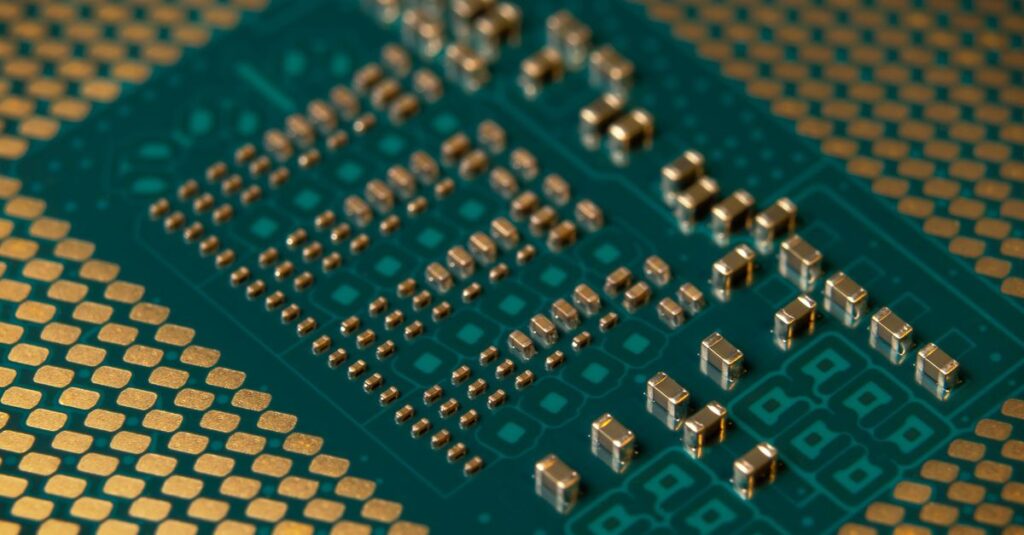
Arm chief executive Rene Haas says artificial intelligence will help cure cancer within our lifetimes, but the same boom is running the chip industry out of capacity. In a BBC interview broadcast this month, Haas described the semiconductor business as an absolutely supply-constrained environment and said memory chip prices have risen sharply as a result.
Haas made the comments in the BBC’s Big Boss Interview series with economics editor Faisal Islam. More than 350 billion chips using Arm technology have shipped worldwide, and Arm designs sit inside almost every smartphone on Earth. He called health the killer app for the technology, pointing out that drug development takes around 20 years and roughly 95 percent of research and development efforts fail. AI, in his argument, will shorten both the discovery phase and the testing phase, with some human trials eventually supplemented or replaced by AI modelling.
“I believe in our lifetime, AI will help cure cancer,” Haas told Islam.
The caveat came immediately. The world cannot manufacture enough chips to meet the demand AI is generating. Asked whether the shortage is a temporary bump, Haas answered: “If it’s a bump, it’s a really, really big bump.”
Where the shortage shows up
The squeeze is already visible in consumer prices. Memory chip prices have climbed sharply, smartphones are becoming more expensive, and handset demand is under pressure. Apple raised iPad and MacBook prices this summer, saying it could no longer shield customers from soaring memory and storage costs driven by the AI datacenter buildout. Micron, one of the three big memory makers, has signed multi-year take-or-pay deals with customers including Nvidia worth $22 billion to lock in supply, a deal structure that requires clients to either buy the chips or hand over cash. Memory stocks like Sandisk, Western Digital and Seagate have rallied on the back of that demand picture.
The shortage reaches beyond memory. Samsung’s Taylor fab in Texas has begun pilot production of 2nm chips ahead of mass production targeted for early next year, with orders lined up from Tesla and Arm-based AI clients. Samsung’s foundry recovery depends on proving mass-production yields to those big clients, and internal process stability indicators are reportedly favorable, with 4nm yield stabilized above 80 percent. The company is closing in on TSMC, whose lead in advanced nodes remains comfortable but no longer unchallenged.
Haas also drew a line between the current AI boom and the dot-com crash he lived through. He said a correction in technology company valuations is possible, but argued that today’s computing capacity is being heavily utilized rather than sitting idle, so a fall in valuations would not necessarily mean a collapse in AI demand. He expects AI to become embedded across businesses and everyday technology either way.
On the more exotic end of the debate, Elon Musk and Jeff Bezos have both floated large-scale data centers in space. Haas was dismissive of the timeline. “We need more fabs before we can put a data centre in space,” he said.
Arm’s own pivot
The interview came as Arm changes shape. After decades of licensing chip designs to other companies, it has begun supplying complete data-center chips of its own. Demand for its new Neoverse product rose from around $1 billion to more than $2 billion within five months, with customers including Meta, Oracle, Cloudflare and SK Telecom.
That shift puts Arm in more direct competition with some of its own licensees, including Nvidia and AMD, and it explains why the company is talking about capacity constraints rather than demand. The industry’s constraint is fabrication, not design. New fabs take years and tens of billions of dollars to build, and Haas said he expects supply pressure to continue.
| Arm by the numbers | Figure |
|---|---|
| Arm-based chips shipped worldwide | 350 billion+ |
| Neoverse demand, five months ago | ~$1 billion |
| Neoverse demand now | $2 billion+ |
| Neoverse customers named | Meta, Oracle, Cloudflare, SK Telecom |
What it means for the AI trade
The interview lands in a week when AI sentiment is already shaky. SoftBank, Arm’s majority owner and OpenAI’s largest corporate backer, dropped 11 percent in Asia on Monday after Sam Altman endorsed Anthropic’s call to slow frontier AI development for safety reasons. The selloff spread across AI-linked stocks in the region. Nvidia is reportedly in talks to put up to $10 billion into Anthropic’s IPO, which seeks up to $100 billion at a valuation near $2 trillion.
Haas’s supply argument cuts against the bear case in one respect. If the constraint is physical capacity rather than enthusiasm, then demand is real even when valuations wobble. But it cuts the other way for consumers and device makers: constrained memory and leading-edge wafer supply means higher bills of materials, and those costs are already being passed through into retail prices. Fujitsu, meanwhile, plans to start exporting its Monaka AI processors, built on Fugaku supercomputer technology and made by TSMC, to the US and Asia next year, adding another supplier racing into the same crowded field.
Microsoft gave its own answer to the capacity problem last week, saying it plans to more than triple data center capacity by 2032, from roughly 12 gigawatts today to more than 38, after shortages forced it to turn away AI and cloud business.
For the chip industry, the message from one of its central figures is blunt. Demand is not the problem. Building enough factories fast enough is, and that problem will not be solved within a product cycle. Until new capacity comes online, expect the costs to keep landing on the price tags of phones and laptops.