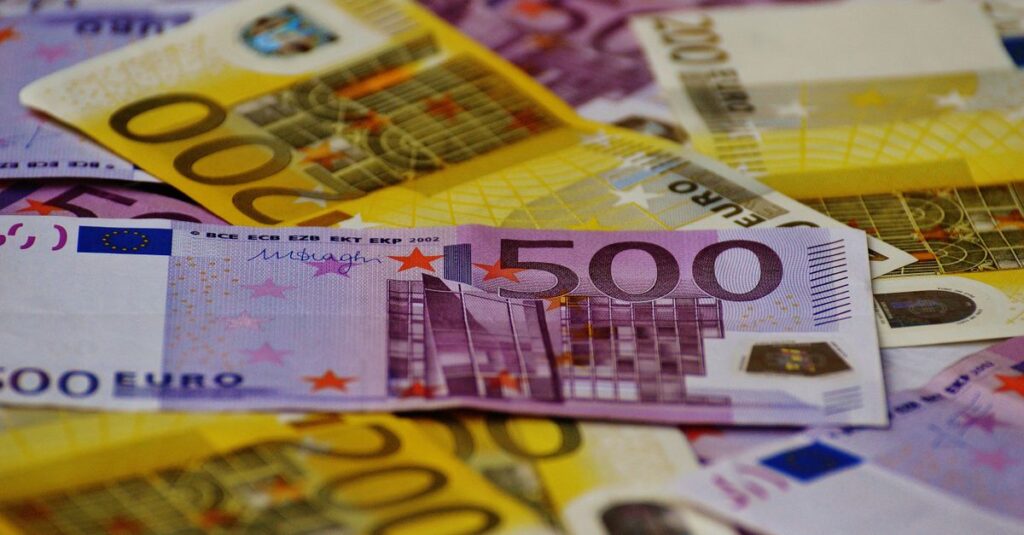
The euro fell to a 17-month low against the dollar on Monday, sliding to around $1.1161 in Asian trading, as France’s borrowing costs hit their highest levels since 2002 and Spain called a snap general election. Two consecutive weekly losses and a widening French-German spread have investors again talking about a eurozone debt crisis, even as the European Central Bank tries to avoid being drawn deeper into the mess.
The currency’s slide leaves the 19-member bloc’s benchmark at its weakest level against the dollar since May 2025. The DXY dollar index, which tracks the euro against a basket of peers and where the euro carries a 57.6% weighting, climbed to 102.5 in early European trading. Analysts at ING said that if the bond sell-off extended, the market could “easily add another 2% in risk premium to the euro.” For European importers and anyone pricing global commodities, that is a headwind that arrives without a single press release.
France at the centre of the storm
The spread between French and German 10-year bond yields stands at roughly 146 basis points, after its largest weekly rise in 17 years, according to data provider LSEG. France’s 10-year yield climbed to 4.917% in early trading Monday, close to last week’s 24-year high. French Finance Minister Roland Lescure used the weekend to insist France remained a solid borrower, unveiling a 2027 budget that aims to cut the deficit from 5.4% of GDP to 5% ahead of next spring’s presidential election.
Investors are not yet persuaded that arithmetic moves markets. Last week’s sell-off did not stay in France. Italian, Belgian and Greek bonds also sank, while German debt drew safe-haven demand. Analysts at Belgian bank KBC warned of “clear contagion towards the likes of Belgium or Italy,” noting that Italy’s premium over Bunds approached 110 basis points last Thursday. Traders flagged echoes of 2011, when the last serious European debt crisis forced the ECB to intervene at scale. The biggest single market casualty was IG Group, down more than 27% after the broker cut its 2026 revenue growth outlook to mid-single digits from a prior 10% to 15% range, a separate sign of how much confidence has drained from European risk appetite.
| Country | 10Y yield vs Bunds | Recent move |
|---|---|---|
| France | 4.917%, +146 bps spread | Largest weekly rise in 17 years |
| Spain | 4.07-4.09%, +65 bps spread | Yields steady despite election |
| Italy | Near +110 bps | Contagion from French selloff |
Spain’s snap election adds another problem
Politics piled on top of the fiscal arithmetic. Spanish Prime Minister Pedro Sanchez called a snap general election for November 29 after parliament rejected two of his minority government’s housing decrees on Friday, in a session framed by weeks of protests over the country’s housing crisis. Spanish bond yields, far calmer than the metric used for France, stood around 4.07% to 4.09% on Monday morning, with a premium over German debt of about 65 basis points, less than half of France’s gap.
European equities opened mixed. France’s CAC 40 fell more than 1%, while Germany’s DAX, the UK’s FTSE 100 and the Netherlands’ AEX traded between 0.1% and 0.3% higher. The broader Stoxx 600 gained 0.6% at the open while the Euro Stoxx 50 slid 0.4%. US stock futures, for once, moved in the other direction, following Friday’s rally after the US added only 29,000 jobs in September. The S&P 500 had risen 0.7% and the Nasdaq Composite 1.2% on Friday, and Nasdaq-100 futures pointed about 0.5% lower Monday as traders waited for the ISM services index release.
The ECB’s bind
The ECB is caught between two jobs. It has been raising rates twice since June to tame inflation, which hit 3.8% in September, a rate well above the bank’s 2% target. But traders have pared bets on more hikes, and the euro’s slide cuts the other way by pushing up import costs. Germany’s Bundesbank chief Joachim Nagel, a candidate for the next ECB presidency, said the bank’s focus was price stability, not “certain spread levels,” a line aimed squarely at anyone hoping for early bond-market backstops.
The bank’s Transmission Protection Instrument, the bond-buying backstop created in 2022 to curb fragmentation between member states’ borrowing costs, has never been used. ECB President Christine Lagarde told French daily La Croix last week that “when your debt is close to 120% of GDP and not on course to be brought under control, it’s a serious matter,” but stressed “it’s not 2008 or 2011.”
The French central bank has its own public message. Governor Emmanuel Moulin, speaking to the Financial Times on Monday, said “France is not Greece during the Eurozone crisis.” He added that if France can pass a budget this year to reduce spending and narrow the deficit as proposed, “markets will be reassured by this concrete step of fiscal consolidation.” He also warned, in the same interview, that “if we don’t act, there is indeed a risk of being gradually strangled by rising interest rates.”
“France is not Greece during the Eurozone crisis. If it can pass a budget this year to reduce spending and narrow the deficit, then markets will be reassured.” – Emmanuel Moulin, governor, Banque de France
What it means for markets elsewhere
A weaker euro and higher European borrowing costs make an uncomfortable backdrop for risk assets, including crypto, which has been rallying on expectations of a rate cut. The dollar strength makes globally priced commodities, from oil to bitcoin, more expensive for holders of other currencies. For the Fed, the eurozone mess is a warning about fragility abroad rather than a direct policy input, but it adds to a sense of global financial stress the Fed would prefer not to inherit ahead of its Oct. 28 meeting.
The next data the market watches is Thursday, when Spanish bond auctions and a swath of European final PMIs land, and traders look for whether the French spread can stabilise or whether the euro’s slide builds again through the back half of the week. A durable spread widening past 150 basis points, which is roughly where this chart peaked in the 2011 crisis, is the line that would turn a market story into a political one.