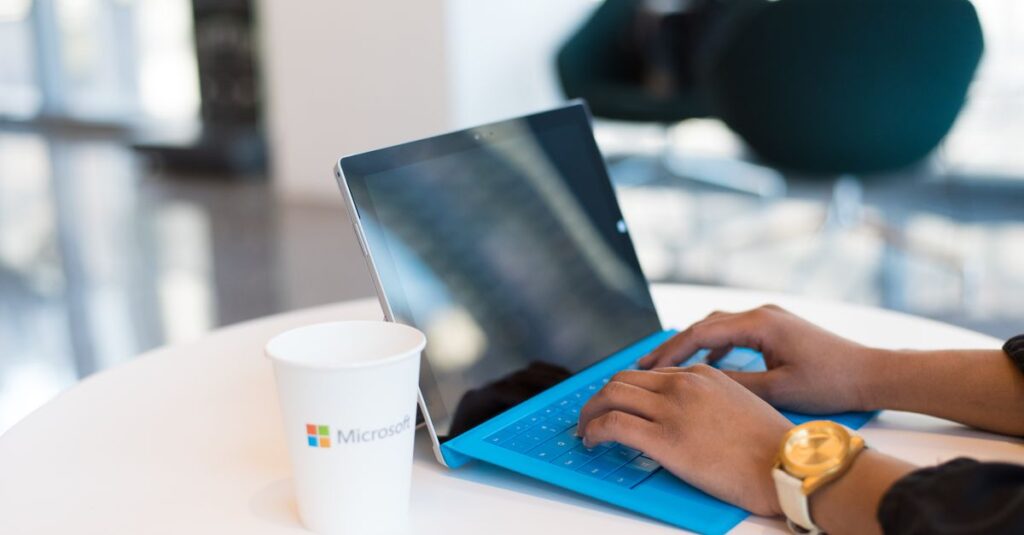
Microsoft announced a new Surface Ultra laptop on Wednesday, a premium machine built around Nvidia’s RTX Spark processor and priced at $2,599, with shipping set for October 16.
The company pitched the laptop around “hybrid intelligence,” its term for splitting AI work between cloud models and models running on the device. The RTX Spark chip, which Nvidia announced earlier this year, handles the local side of that split. Microsoft says the design lets the laptop run AI features without sending every request off the machine.
The price is the story within the story. Surface hardware has always sat at the premium end of the Windows market, but $2,599 puts the Ultra above most consumer laptops outright and into MacBook Pro territory without Apple’s battery-life track record. Microsoft is betting a segment of buyers will pay that number for a Windows machine positioned as an AI-native device rather than a general-purpose laptop.
Why on-device AI matters to Microsoft
The strategy has two drivers. First, privacy and latency: features that run locally, transcription, summarization, image editing, do not require audio or documents to leave the machine, and they respond instantly rather than waiting on a network round trip. Microsoft’s Recall feature showed how much consumer trust depends on that line; the original cloud-tethered design had to be reworked after security researchers and buyers pushed back.
Second, infrastructure economics. Microsoft has spent tens of billions on data center capacity to serve OpenAI’s workloads, and cloud GPU time is not free to the company or the customer. Moving routine per-user AI queries to a processor in the laptop relieves some of that load and makes the per-user cost of an AI subscription easier to manage. On-device inference is a cost story as much as a feature story, and every point of load Microsoft shifts off its data centers compounds across millions of Copilot subscribers. An enterprise fleet of ten thousand seats running most summarization locally is a different margin equation than the same fleet round-tripping every query.
Microsoft is not alone in this bet, which is the point. Qualcomm’s Snapdragon X series, Intel’s Lunar Lake and AMD’s AI-accelerated mobile chips all sell Copilot+ PC-class hardware, and every major Windows OEM has a low-power NPU in the lineup this year. What distinguishes the Ultra is the compute bracket: RTX Spark is positioned closer to a laptop GPU with AI headroom than the efficiency-first NPUs most Windows machines ship with. That means heavier local models, longer context for document work and, in theory, features competitors’ machines cannot run at acceptable speed. For Nvidia, it is also a rare consumer-side design win, since the company’s revenue to date has come overwhelmingly from data center accelerators rather than laptops.
The crowded market it walks into
The Ultra arrives into a segment where pricing power is being tested. Apple’s MacBook Pro line continues to absorb the top of the creator market, and the M-series update cycle has kept the Windows Intel-clone aisle fighting on price instead. A $2,599 Windows laptop has to justify itself against a comparable MacBook that runs its own on-device AI features and has, until recently, better build-to-price perception.
There is also the AI-PC label problem. Market research firms group hundreds of laptop SKUs as “AI PCs” because they contain an NPU, and the sales numbers look strong, but actual software that uses the NPU has been sparse. Buyers so far get silicon they paid for and features they mostly do not use. Microsoft’s answer with the Ultra is to make the local model part of the pitch directly rather than as a checkbox in a spec table, and the company has history here: the Surface line has always been a design exercise meant to pull the OEM ecosystem in a direction, more than a volume business on its own.
The timing also matters relative to Microsoft’s own platform moves. Windows AI features have rolled out unevenly across Copilot+ and non-Copilot+ machines, and the company has faced criticism for gating flagship features to newer hardware. Shipping a machine that is the reference platform for its own AI stack gives Microsoft a clean answer to that criticism, one device where everything works as demoed.
What Microsoft did not announce matters too. No word on a smaller Ultra variant, no new double-digit battery-life claim tied to the RTX Spark platform, no per-model pricing for the cloud side of the hybrid design. The October 16 ship date is close enough that the remaining details will surface in reviews rather than keynotes, and reviews are where a $2,599 bet gets tested.
What happens next
The launch window splits: pre-orders begin at the announcement, hardware reaching the first buyers in the week of October 16. During the holiday quarter the competing pitch will play out in showrooms, the Ultra’s heavier compute against whatever Apple brings to the MacBook line in the same months.
The broader question is whether on-device AI hardware converts into software buyers actually use. The industry spent two years building NPUs into every new laptop, and the app catalog is still thin. If the Ultra’s local AI stack gets daily use in reviews, other OEMs will chase the same bracket with Nvidia silicon, and Nvidia gains a consumer laptop story to balance its data center business. If it becomes another dormant chip, the premium-AI-laptop category stalls at a rounding error, and the AI-in-every-device pitch loses its flagship demonstration case.