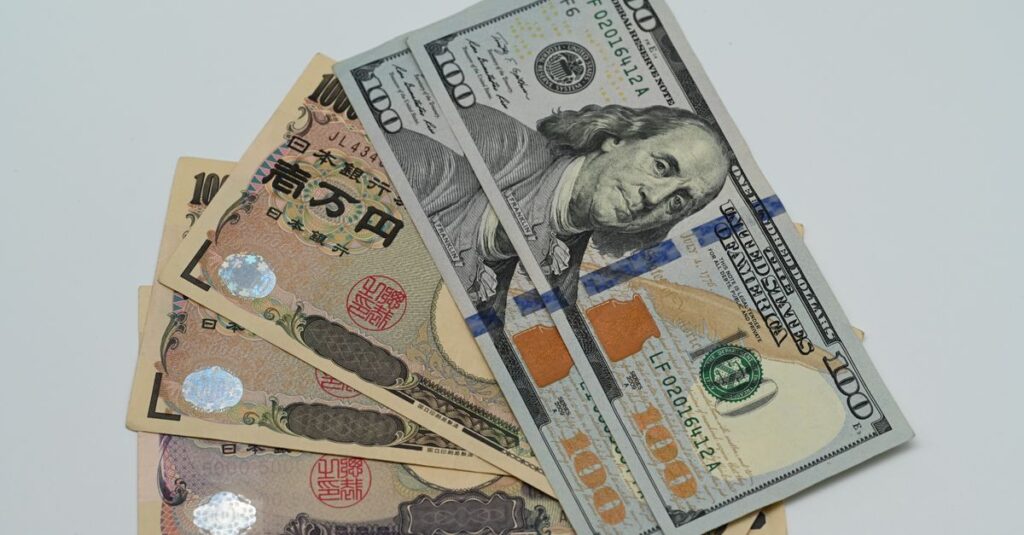
The Bank of Japan raised its benchmark rate by 25 basis points to 1.25% on Friday, the highest level in 31 years, and the yen fell anyway. USD/JPY pushed above 157 within hours of the decision, reaching an intraday high near 158.
The move was widely expected. What surprised markets was the vote: two of nine board members dissented against the hike, a split that traders read as the Takaichi administration leaning against faster tightening. Governor Kazuo Ueda said the bank would continue raising rates if the economy and prices move as projected, but would now balance upside and downside risks rather than prioritizing downside ones.
The yen had already been sold through the week. The Federal Reserve raised US rates on Wednesday, its first hike in three years, which widened the gap the carry trade feeds on. By Friday evening Tokyo had also run a “rate check,” questioning market participants about exchange-rate levels, a step that often precedes official currency intervention. The yen briefly recovered to 156 before sliding again.
The carry trade arithmetic
The mechanics are simple and the scale is not. Investors borrow yen cheaply in Japan, convert, and buy higher-yielding assets abroad: US stocks, bonds, anything paying more than a Japanese deposit. As long as the yen stays stable or falls, the position earns the spread. When the yen rises sharply, those same investors must buy yen back to repay loans, which pushes the yen higher still and can force waves of selling in the assets the borrowed money bought.
How much money is parked in that trade is hard to measure, but Jefferies analysts, working from Bank for International Settlements statistics, put yen borrowing outside Japan at a record 360 trillion yen as of March, up from 216 trillion yen in December 2021. That is roughly $2.3 trillion of short positions on the currency scattered through loans, forwards and derivatives.
Past unwinds have left marks. In August 2024, a BOJ hike and soft US data combined to send the yen surging, and the resulting liquidation dragged global equities lower within days, one of the sharpest volatility spikes of that market cycle. The episode is the standing case study in why Tokyo’s normalization path worries traders far from Tokyo.
Why this hike did not lift the yen
Three things worked against the currency on Friday. The Fed’s own hike kept US rates elevated, so the yield gap narrowed only slightly. The dissenting votes signaled internal resistance to further tightening, softening expectations for the next move. And markets have spent two years concluding that the BOJ is behind the curve, a judgment that survives individual meetings.
The bank’s statement added a novel worry: it flagged rising semiconductor prices, driven by global AI investment, as a channel that could spill into consumer prices. That framing gives the BOJ cover for further hikes, but it also confirmed that Japanese policy is now reacting to an inflation problem rather than engineering one, a shift markets are still pricing.
US Treasury Secretary Scott Bessent had publicly pressed Tokyo to tighten faster in recent weeks, an unusual intervention into another sovereign’s monetary policy that apparently failed to move the currency either.
What markets are watching now
The rate check late Friday is the nearest-term signal. Japan’s Ministry of Finance has historically paired rate checks with jawboning before intervening to buy yen, and it spent billions doing exactly that in 2022 and 2024. Intervention would reverse the currency move mechanically, but past episodes have shown the effect fades unless rate differentials also close.
For global markets the question is whether the unwind comes gradually or in bursts. Japanese rates remain far below US rates, so carry trades still earn their spread, which argues for a slow bleed rather than a shock. The risk case, as analysts at several banks describe it, is concentrated in US technology stocks, where yen-funded positions have grown alongside AI-related valuations. A fast yen rally would force selling into those same positions.
The week’s other central bank moves frame the backdrop. The Bank of England held at 3.75% in a 6-3 vote but warned inflation risks had tilted further upside after the energy shock from the Middle East war. The Fed’s dot plot signaled one more hike this year. September has brought the largest rise in average G10 policy rates since July 2023, with borrowing costs rising everywhere at once.
Risk assets and the unwind question
Bitcoin and other risk assets watched the episode without damage: bitcoin climbed above $80,000 on Friday as traders concluded that a gradual BOJ path poses less systemic risk than the 2024 unwind did. European equities fell modestly Friday and Wall Street mixed, with weekly losses on the S&P 500 and Dow despite Friday’s partial recovery.
Oil added its own layer of stress. Brent traded near $100-105, kept there by the Middle East war and constrained Gulf exports, which feeds the inflation problem every central bank at the table is fighting. The Bank of England’s governor said inflation spillovers from the conflict had stayed subdued so far, a hope rather than a forecast.
For global markets the unwind question is whether it comes gradually or in bursts. Japanese rates remain far below US rates, so carry trades still earn their spread, which argues for a slow bleed rather than a shock. The risk case, as analysts at several banks describe it, is concentrated in US technology stocks, where yen-funded positions have grown alongside AI-related valuations. A fast yen rally would force selling into those same positions.
The next test arrives at the BOJ’s next meeting and in Washington’s inflation prints. If US yields keep climbing and Japanese hikes keep coming in 25-basis-point steps, the carry trade holds. If either side moves faster than expected, the 360 trillion yen question becomes the market’s problem again.