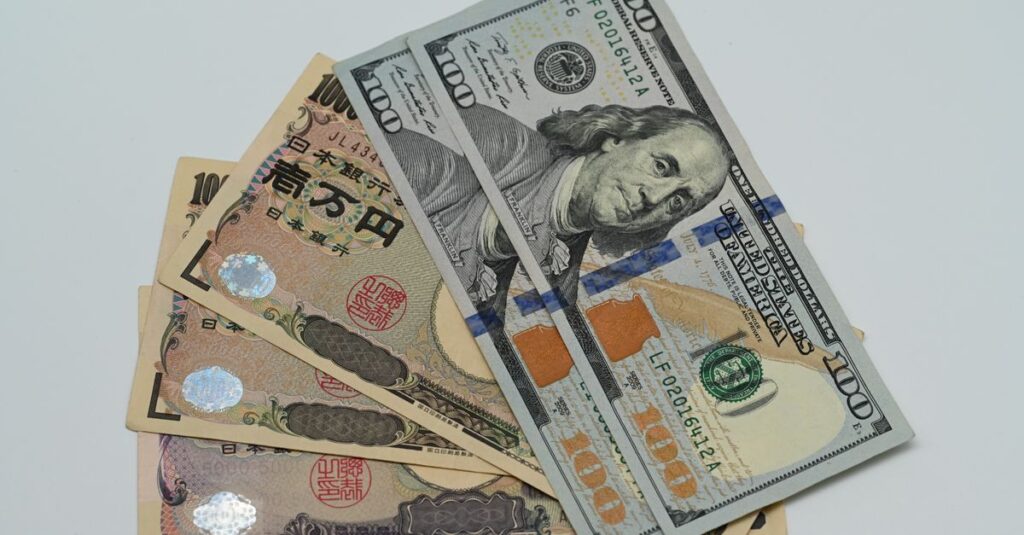
The yen jumped to the upper 156 range against the dollar in New York trading after Japanese Finance Minister Satsuki Katayama and US Treasury Secretary Scott Bessent reaffirmed in a call that the yen’s undervaluation is a problem. The currency had traded in the lower 158 range hours earlier, meaning it was bought back by nearly two yen on the news. It was the biggest daily gain against the dollar since September 7.
The call, held on the night of September 25 Japan time, was the first confirmed coordination between the two sides since late July, when Japan and the United States carried out their first joint yen-buying intervention in 28 years. According to Japan’s Ministry of Finance, both sides exchanged views on financial market developments and signaled a stance of pushing back against yen depreciation and dollar strength.
Bessent went further in public remarks. In a post on X, he said he had a productive call with Katayama and that they discussed the desirability of a stronger yen reflecting Japan’s solid economic fundamentals, along with the importance of close communication on currency markets. Kyodo News reported the exchange as breaking news shortly after midnight Japan time.
Trump’s concern set the stage
The call followed a summit earlier in the week between President Donald Trump and Japanese Prime Minister Sanae Takaichi in New York. Katayama told reporters after a cabinet meeting that Trump raised concern about the weak yen during the meeting on September 22, and that Takaichi responded that, generally speaking, the yen’s undervaluation is problematic.
Katayama also suggested markets may have misread the outlook. She said she expects excessive yen selling to ease, hinting there may have been some misunderstanding in the market and that the trend could reverse. That framing matters for traders: it signals Tokyo sees the recent weakness as speculative rather than fundamental, which is the justification it has historically used before intervening.
I had a productive call with Minister Satsuki today. We discussed that a stronger yen reflecting Japan’s solid economic fundamentals is desirable, as well as the importance of maintaining close communication regarding the foreign exchange market.
Why the yen kept sliding
The intervention in late July pushed the yen from around 164 per dollar back to the 155 level, but the currency turned weak again in the weeks that followed and was approaching 160 before this week’s events. Markets judged the Bank of Japan’s rate hike earlier this month, which took rates to a 31-year high, as insufficiently hawkish, and the yen was on track for a second weekly fall before the call.
The backdrop is a global bond selloff that has lifted yields everywhere. Japan’s 10-year yield touched 3.121 percent this week, a level not seen since 1996, while the US 10-year traded above 5.1 percent after hitting its highest since 2007. Rising Japanese government bond yields complicate the picture for Tokyo: they make the yen more attractive to carry traders unwinding, but they also raise Japan’s own debt service costs and can spill into US Treasury yields, a point Bessent has reportedly flagged.
| Date | Event | Yen move |
|---|---|---|
| Late July | First joint US-Japan yen-buying intervention in 28 years | From about 164 to the 155 level |
| Mid-September | BOJ hikes to 31-year high, guidance seen as insufficiently hawkish | Yen resumes weakening toward 160 |
| September 22 | Trump raises yen concern in summit with Takaichi | Market attention on intervention risk builds |
| September 25 | Katayama-Bessent call reaffirms undervaluation concern | From lower 158 to upper 156 range |
The intervention mechanics are worth spelling out. When Japanese authorities bought yen in late July, they did it by selling dollar reserves, and the scale of that operation, estimated by markets in the tens of billions of dollars, drew attention to Japan remaining firepower. The Ministry of Finance does not publish a hard budget for intervention, but analysts generally put deployable funds above 600 billion dollars before the July action. Spending another round of that size would draw down reserves further and could tighten dollar liquidity in Japan banking system, which is one reason Tokyo prefers verbal intervention to work first.
Washington involvement changes the calculus in a second way. A joint intervention carries more weight than a unilateral one because it removes the risk that US officials criticize the move or that dollar-buying by Japan reads as currency manipulation. The July action was the first joint yen-buying operation since 1998, when the Asian financial crisis was raging, and its effectiveness showed in the immediate move from 164 to 155. The subsequent drift back toward 160 shows the limit of one-off action when rate differentials keep favoring the dollar.
For Japanese importers and households, the stakes are concrete. A weak yen raises the cost of energy and food imports, both of which Japan buys largely in dollars, and it feeds the inflation that has kept Japanese wages and prices in the news for three years. The Bank of Japan has been raising rates partly to defend the currency, and a sharper turn toward hawkish guidance would be the next lever if the FX market does not cooperate.
What comes next
Neither side ruled out further coordinated intervention in their statement after the July action, and Friday’s call keeps that option visible without committing to it. For currency markets, the message is that the 160 level now carries real risk of official selling of dollars. Speculative yen-selling positions built up over the summer face a wall of verbal and possibly actual resistance.
The dollar still has support elsewhere. Expectations for a Federal Reserve rate hike at the October meeting stood near 66 percent on CME FedWatch, up from about 58 percent a week earlier, and five of the G10 central banks have raised rates this month. That keeps the rate differential in the dollar’s favor and limits how far the yen can rally on rhetoric alone. But the coordination signal is unusual: Washington rarely asks for a weaker dollar explicitly, and Bessent doing so removes the main obstacle that limited Japanese intervention effectiveness in past episodes.
Traders will watch whether Japan follows through with actual intervention if the yen slides again, and whether the Bank of Japan sharpens its guidance at its next meeting. For now, the two finance ministries have restated their position from July, and the market moved nearly two yen on the reminder.