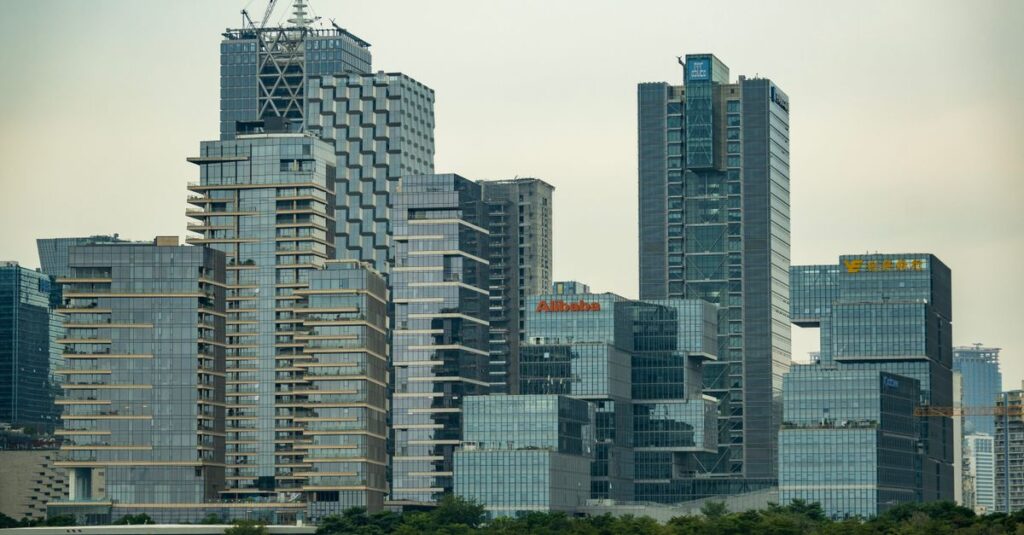
HANGZHOU, China – Alibaba has laid out an AI roadmap spanning chips, cloud infrastructure, models and software agents, confirming at its annual Apsara Conference that the next generation of its Qwen model family has entered training. The company also sketched a longer-term plan for models that could reach 10 trillion parameters, an order of magnitude above the largest open releases to date.
The Apsara Conference is Alibaba Cloud’s annual technology event, and this year’s edition read as a statement that the company intends to compete across the full AI stack rather than specialize in any one layer. Qwen project lead Liu Dayiheng said on stage that Qwen 4 is in training now, with follow-on versions, Qwen 4.5 and Qwen 5, projected to scale from 5 trillion to 10 trillion parameters.
The chip and the hardware line
The hardware centerpiece was the Zhenwu V900, a data center chip Alibaba claims extends its in-house silicon strategy. Alibaba’s chip unit, T-Head, previously built the Yitian 710 server CPU for the company’s own cloud data centers, so Zhenwu is the successor in a line Alibaba uses to reduce its dependence on Nvidia and to cushion the impact of US export controls.
The company also published a roadmap for future Yitian CPU generations. In-house silicon matters commercially for Alibaba because Alibaba Cloud sells compute, and every workload served on Alibaba-designed chips is a workload that does not need foreign accelerators under license review. The margin math compounds: capacity built on first-party hardware also returns more income per dollar of capital deployed, assuming performance holds. Alibaba shares rose about 5 percent the day it unveiled the chip strategy in late September, per Reuters.
Eddie Wu, Alibaba’s chief executive, said Alibaba Cloud aims for its global data center capacity to surpass 20 gigawatts by 2032. For comparison, large AI training sites in 2026 typically run in the hundreds of megawatts, and the largest single campuses under construction top out around one gigawatt. Twenty gigawatts globally would put Alibaba Cloud in the same conversation as the biggest US hyperscalers in power terms, and implies a build program measured in tens of billions of dollars. Landing it also depends on grid connections and energy deals in every market where Alibaba Cloud operates, which is where similar growth targets at other clouds have slipped.
Models, agents and a crowded field
On the software side, Alibaba announced updates to its multimodal models, an agentic cloud offering that runs autonomous tasks on its infrastructure, and a mobile AI agent platform. The company said future Qwen models are aimed at what Wu called more complex, longer-horizon tasks, jobs that require an agent to plan and execute over hours rather than answer in one turn. That framing lines up with where the wider industry sees the next product battle, since frontier labs have spent 2026 moving from chat toward supervised autonomy in coding, research and operations work.
Qwen has been open-sourced in multiple versions and sizes, which drove wide adoption among developers priced out of frontier closed models, and transformed Alibaba Cloud from mainly an e-commerce infrastructure provider into one of the largest AI model ecosystems outside the US. The open model also matters to China’s AI posture, since domestic firms gaining global developer mindshare offsets some of the restrictions built around Chinese access to leading US chips.
The aggressiveness of the parameter targets is difficult to verify independently. Ten trillion parameters would be roughly ten times the size of very large open models from 2025. Parameter count alone stopped being a reliable measure of model quality years ago, as training data, compute allocation and post-training methods determine most of the performance gap between models. Alibaba’s targets are effectively a statement about the compute it plans to own, not a capability guarantee. On the other hand, they do signal how much the company is willing to spend, and spending discipline, or the lack of it, will shape returns for both Alibaba and its cloud customers over the next two years.
Why it matters outside China
For global AI watchers the announcement confirms two trends. One is that hyperscale cloud providers outside the US are now packaging frontier-model training, custom silicon and agentic products in the same bundle, which puts real competitive pressure on Western cloud pricing. The other is the continuing rise of open models as a strategy for global developer adoption, since every Qwen release expands the base of applications built on Alibaba’s tooling.
For enterprises the practical takeaway is more negotiating room. Multi-cloud buyers can now point to a non-US vendor with plausible frontier performance and its own hardware, and procurement teams have started using exactly that leverage in contract renewals. Whether Alibaba Cloud can sell the full stack outside Asia depends on data residency rules and political weather, neither of which a conference keynote controls.
Regionally, Alibaba Cloud says it is Asia-Pacific’s largest cloud provider by revenue, and the roadmap is aimed at keeping that position as US competitors invest heavily to catch up in the region. Southeast Asian governments signing sovereign cloud deals, several with Alibaba over the past three years, are the anchor customers for that argument, and each deal is a referendum on whether the US export-control squeeze on Chinese chips is a business risk or a competitive opening for domestic alternatives.
Investors will watch two concrete variables. The first is Zhenwu V900’s commercial deployment, and whether Alibaba Cloud discloses the share of its training fleets running on first-party chips. The second is the actual release of Qwen 4 and the benchmarks it posts against frontier models from OpenAI, Google and Anthropic. Between those two milestones, the roadmap is ambition on paper, and the market has learned to price late-stage ambition with patience.