
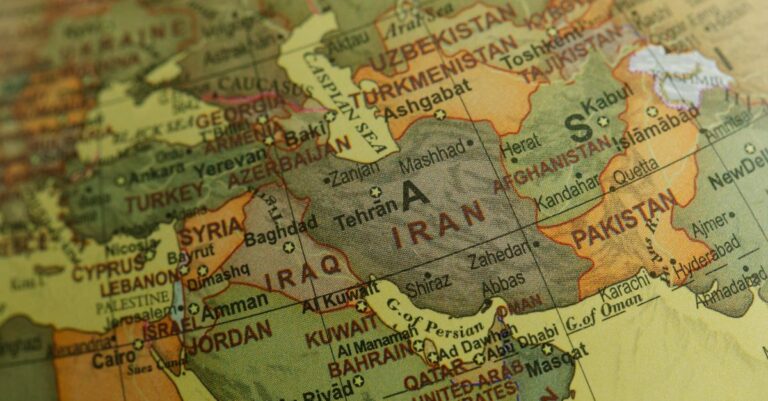
Iran’s Islamic Revolutionary Guard Corps launched retaliatory missile and drone strikes against US military bases in Jordan and the United Arab Emirates on Sunday night, hours after a US drone attack killed two people on Iran’s Larak Island in the Strait of Hormuz. The escalation marks the most significant direct military exchange between Washington and Tehran since late July, raising fears of a broader regional conflagration across the Middle East and sending oil prices sharply higher in early Monday trading across global commodity markets.
The IRGC confirmed it targeted the King Faisal and Prince Hassan military bases in Jordan, claiming to have struck an F-15 fighter jet preparation hangar and a residential area housing US military personnel. Iran’s state broadcaster IRIB reported that several Iranian fighters and civilians were killed or wounded during the earlier US strike on Larak Island, a small island positioned near the strategic Strait of Hormuz waterway that connects the Persian Gulf to the Gulf of Oman and the open sea beyond.
US Base Attacks Across Two Countries
In a separate operation, Iran said it targeted US helicopter positions and personnel stationed at the Al Minhad Air Base in the UAE using dozens of attack drones. State media presented the UAE strike as a direct response to the Larak Island attack. Fox News reporter Trey Yingst, citing a US source, reported that nearly all incoming missiles were intercepted at the bases, though the IRGC separately claimed to have shot down a US MQ-9 Reaper drone over the Strait of Hormuz.
The Pentagon has not confirmed any US casualties or acknowledged the reported loss of the MQ-9 drone. President Trump, commenting on the strikes, reiterated that Iran must not be permitted to develop nuclear weapons and referred to Iranians as violent. Iran’s foreign ministry issued a statement condemning what it called American military aggression on Larak and said its forces responded in accordance with the inherent right of legitimate defence under international law.
Larak Island Strike Was First US Attack on Iran Since Late July
The US attack on Larak Island struck two IRGC rocket launcher systems, according to Reuters citing a US official. It was the first known American strike on Iranian territory since a heavy wave of strikes on July 29, carried out in response to an attempted attack on US military positions the day before. Tasnim News Agency, linked to the IRGC, reported that a drone carried out the Sunday strike, killing two people and wounding two others on the island.
The timing was notable given recent diplomatic signals from Washington. Secretary of State Marco Rubio had told allies in recent days that the US was not expecting to conduct renewed strikes on Iran for the time being. An internal State Department document obtained by US media indicated the department was preparing to send diplomatic staff back to embassies in the Middle East and scale back emergency measures undertaken since the conflict began in February. The Larak Island operation appeared to contradict those signals, suggesting a possible split between the State Department diplomatic track and Pentagon military planning.
Strait of Hormuz Escalation and Oil Markets
The Larak Island strike came just days after US military engineers finished clearing all mines from the Strait of Hormuz main shipping lane, an operation the Trump administration had touted as restoring safe passage through one of the world’s most critical oil chokepoints. The strait, through which roughly a fifth of globally traded oil and natural gas passes, has been the focal point of the US-Iran conflict since February when Washington and Jerusalem launched Operations Roaring Lion and Epic Fury against Iran.
Oil prices jumped more than one dollar per barrel in early trading on Monday as news of the retaliatory strikes spread, reversing a brief period of calm that had followed the mine-clearing operation. Insurance premiums for vessels transiting the strait, already elevated since the conflict began, were expected to climb further in the coming days as shipping companies reassessed risk across the region.
Iran’s Supreme Leader Mojtaba Khamenei issued a written appeal to Gulf Arab rulers hours before the strikes, urging them to recognise their real enemy, understand its plans and confront it. The appeal was seen as a last-ditch attempt to rally regional support before the expected escalation. Oman’s foreign minister visited Tehran on August 25 to continue negotiations on management of the strait, with Iran’s deputy foreign minister claiming an agreement had been reached, though a senior Iranian source told international media the deal was not finalised.
Background: Six Months of War
The conflict has now entered its seventh month. It began on February 28 when Israel and the US launched coordinated strikes against Iran, killing Supreme Leader Ayatollah Ali Khamenei in a bunker strike on Tehran along with the defence minister and several IRGC generals. Iran retaliated by firing ballistic missiles at Gulf nations and US military bases across the region, and closing the Strait of Hormuz to commercial shipping.
A ceasefire deal was announced on April 7 and went into effect the following day, but it proved short-lived. Cross-border exchanges continued, and the IRGC established a maritime blockade that disrupted global oil supply chains for months. At least 18 US soldiers have been killed according to CENTCOM figures, while Israeli forces have lost 39 soldiers and 23 civilians in ballistic missile attacks since the war began. Iran’s casualty figures remain disputed, with independent estimates suggesting significantly higher military and civilian deaths across the country.
No fresh diplomatic framework is currently on the table. The latest US strike on Larak Island and Iran’s multi-country retaliation suggest the conflict is entering a new and more dangerous phase, with the potential to draw in Gulf states, Jordan, and other regional actors who have so far maintained a precarious neutrality while navigating their own security concerns.
discussion