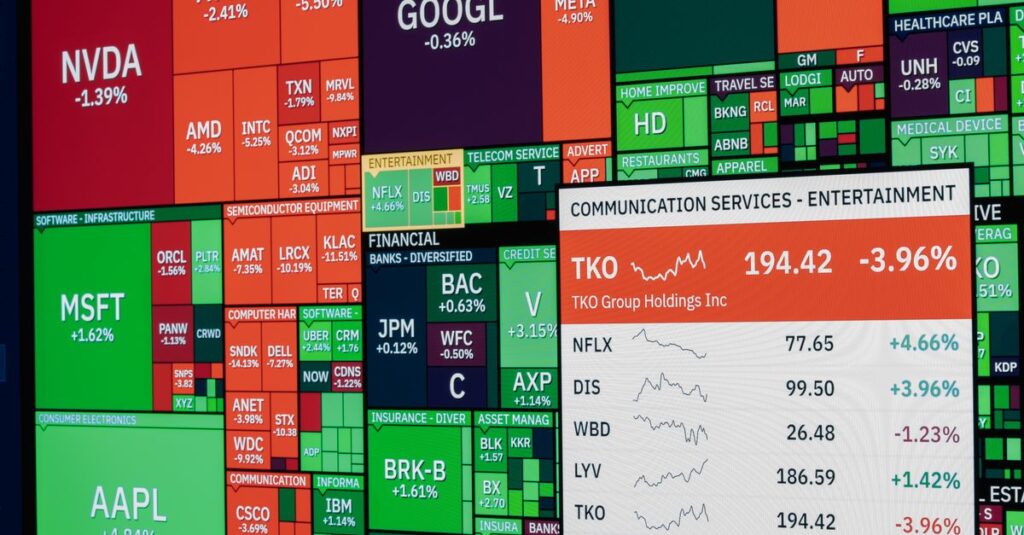
The Nasdaq Composite set a record closing high of 27,122.09 on Monday, its first new peak since June, while the S&P 500 climbed 1.49 percent to 7,764.70 and moved within 0.4 percent of its all-time high. The Dow added 366 points, per CNBC, in the market’s best session since early August.
The trigger was relief on two fronts. Crude oil fell more than 3 percent as traders bet on de-escalation around the US-Iran standoff discussed at the UN General Assembly, and Treasury yields retreated from levels that had rattled markets all last week.
The oil-yield loop
The two moves are linked. Energy inflation had been pushing bond yields higher, with the 10-year Treasury touching 5.04 percent this month, its highest since 2007. That level threatened both corporate borrowing costs and the valuation of long-duration tech stocks, which is why the market spent the past two weeks digesting every oil headline.
When Brent slid toward $100 for a fourth straight session, the pressure came off both at once. Yields fell, rate-hike expectations priced into US markets eased, and investors rotated back into the AI trade that had carried equities all year. Chipmakers led the advance, with AMD’s record run to a $1 trillion market value on Monday setting the tone. The stock closed at a record after a five-day AI rally that has lifted shares more than 180 percent this year, though it remains far behind Nvidia by revenue and market value.
Wall Street’s rally was not isolated. Asian stocks gained on Tuesday morning, with India’s Sensex and Nifty opening higher as crude cooled, and European shares had already joined the move on Monday. The advance returned the S&P 500 to striking distance of its record while pushing the Nasdaq into new territory, per stl.news.
What eased, and what did not
The relief has limits. Houthi attacks on shipping continue, and Saudi export disruptions from drone damage to a key Red Sea pipeline have not been fully resolved. Riyadh is routing more cargo through ship-to-ship transfers off Oman’s Sohar port, a workaround that adds cost and time. The IEA’s latest monthly report still projects global oil supply declining by 4.3 million barrels per day on average this year, with elevated fuel prices weighing on consumption and global demand expected to fall by 1.6 million barrels per day.
On rates, the Federal Reserve remains the swing factor. Markets price roughly three additional quarter-point hikes through 2027, and the 10-year yield sits near 5 percent even after the pullback. Monday’s rally borrowed against a friendlier oil tape, not against a change in monetary policy.
The Bank of Japan complicates the global picture too. It lifted its policy rate to 1.25 percent, a 31-year high, in a split vote on Monday, yet the yen slid toward 157 against the dollar as traders questioned the pace ahead. A weak yen keeps Japanese capital flowing into US assets, which has quietly supported this equity rally. Carry trades funded in yen remain a pillar of global risk appetite, and every BOJ meeting tests them. The last time the yen approached these levels, in mid-2024, the unwinding of those trades produced one of the sharpest global selloffs of the decade.
Bitcoin in the same current
The risk-on move lifted crypto along with tech. Bitcoin pushed to $87,000 on Monday as leveraged traders chased a run toward $90,000, and US-listed spot Bitcoin ETFs have been taking in hundreds of millions of dollars a day, including a $433 million session last week led by Fidelity’s FBTC with $310.7 million. The correlation between Nasdaq momentum and crypto flows has been one of the more reliable patterns of this market, and Monday was no exception.
Corporate treasuries are riding the same wave. Strategy ended a two-week buying pause with a 950 BTC purchase worth $75.7 million at an average $79,670 per coin, and Bitmine extended its Ethereum streak to 65 consecutive weeks of buying, moving within 0.1 point of its 5 percent supply target.
The cross-asset picture matters for equity investors because crypto has become a liquidity barometer. When leveraged crypto positions get liquidated in size, as happened last week when more than $750 million in positions were wiped out across 136,000 traders, the same risk-model dynamics operate inside equity funds. Monday’s calm suggests those models have reset, but the leverage is already rebuilding.
What to watch next
The question is whether the oil retreat holds. If UN-side diplomacy produces even a partial de-escalation, the disinflation impulse could carry equities through the S&P’s record within days. If attacks on shipping resume at scale, the trade reverses quickly, since the same loop that lifted stocks on Monday can drag them down in a session.
Earnings season gives the next datapoint on whether the AI trade justifies its multiple, and Friday’s US payrolls report will test the market’s assumption that the Fed is done surprising to the hawkish side. A hot print would reprice yields immediately, with or without oil. The last strong payrolls report, earlier this month, dropped Bitcoin below $80,000 within hours and triggered $202 million in long liquidations.
Volatility gauges remain low, which cuts both ways. The S&P 500 VIX sat near 14.5, a level that historically signals complacency as much as stability. Markets that drift to records on quiet tape tend to correct sharply when the tape stops being quiet.
For now, the message from Monday is that investors are choosing to believe the relief. Records tend to attract flows, and flows tend to extend records, until something breaks the loop.