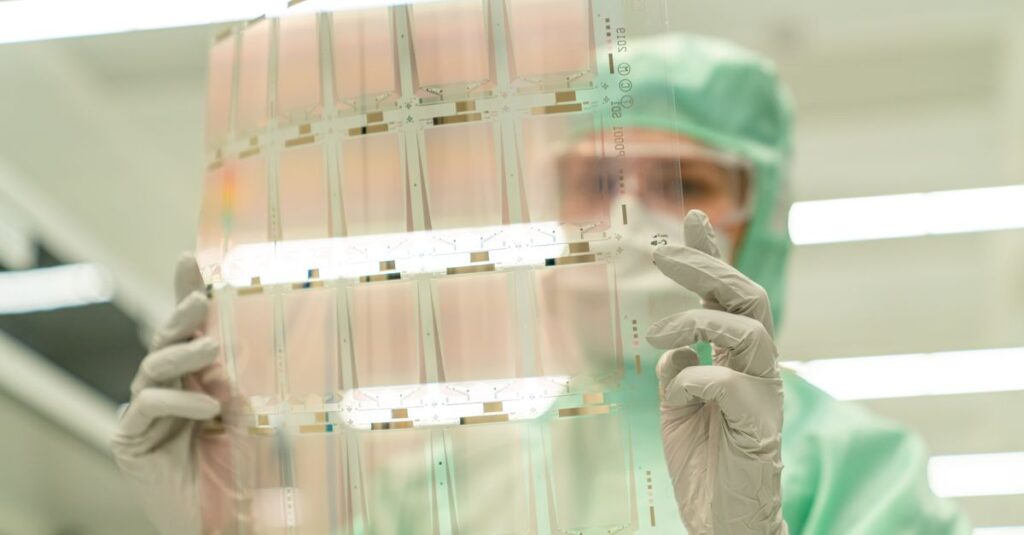
GlobalFoundries signed a five-year, $2 billion manufacturing agreement with TSMC on Thursday to produce silicon interposers for advanced AI chips at its Malta, New York facility, making it the first US plant to build a component currently made almost entirely in Taiwan. Production is expected to ramp up in the first half of 2028.
The deal was announced Thursday by Reuters and confirmed by the company. It sits inside the fast-moving market for advanced packaging, where chips are no longer sold as single dies but assembled into packages that combine processors, memory stacks and other components to move data between them at high speed. The agreement covers capacity expansion at the Malta plant ahead of the 2028 ramp.
What a silicon interposer does
An interposer is a thin slab of silicon placed between a processor and its memory inside an advanced package. It carries the microscopic wiring that lets the two talk to each other at very high bandwidth. Without it, signals have to travel farther and slower across a conventional circuit board.
That makes interposers a bottleneck part for the whole AI hardware industry. Every major accelerator design depends on them. Today the manufacturing supply runs almost entirely through Taiwan, so any disruption there would ripple through data center plans at most large cloud companies and stall shipments of accelerators used for training models and running them.
GlobalFoundries has been investing in its Malta facility for years, initially oriented toward trailing-edge chips for automotive and industrial customers. The new agreement commits TSMC to sourcing interposer volume from that site, and the $2 billion figure covers the capacity build-out needed to reach production in 2028.
Why it took until now
Interposer manufacturing is not easy to copy. It borrows process steps from the kind of advanced fabs that only a handful of companies operate. Most of the existing supply comes from facilities concentrated around TSMC’s home base in Taiwan, and the equipment vendors and process knowledge built up around those sites do not move quickly to new geographies.
That concentration has been a political talking point in Washington for years. Bills aimed at diversifying advanced packaging have been pitched repeatedly, along with subsidy programs. This agreement is among the first concrete commercial results of that pressure, built not on mandate but on a supplier willing to meet TSMC’s yield and defect rate standards.
TSMC had already been forced to diversify some packaging work closer to home, but the interposer layer remained the hardest to move. Bringing it to New York changes the geography of one of the most constrained layers in the AI supply chain.
Effect on AI chip availability
Once Malta comes online, AI accelerator customers buying TSMC chips gain a second sourcing point for the interposer inside their packages. That does not double total capacity overnight. It reduces single-location risk for the component whose shortage would shut down advanced packaging lines entirely.
The deal also lands in a market already under pressure. TSMC reported record September revenue of $16.03 billion, up 54.6 percent year over year, driven in good part by AI chip demand. MediaTek reported September sales of NT$554 billion, up nearly 2 percent. Citi raised its TSMC price target this week, forecasting above 40 percent revenue growth through 2027. More interposer capacity means more total package output once yield ramps, which feeds the same AI buildout driving those numbers.
| Item | Detail |
|---|---|
| Agreement value | $2 billion over five years |
| Component | Silicon interposers for advanced AI packaging |
| Facility | GlobalFoundries Malta, New York |
| Production ramp | First half of 2028 |
| Status | First US source for AI packaging interposers |
| TSMC Sept revenue | $16.03 billion, up 54.6% year over year |
Why packaging matters more than it used to
Chips have become systems inside a package rather than individual parts. An AI accelerator today typically pairs a large processor die with several stacks of high-bandwidth memory, all connected through wiring that runs across an interposer. The speed of data movement between those components now shapes real-world performance as much as transistor speed does.
That shift has changed where value sits in the semiconductor industry. Logic scaling gets slower and more expensive each generation, while advanced packaging grows more valuable. Companies owning that capacity have gained pricing power accordingly. GlobalFoundries, which many in the industry had written off as a trailing-edge foundry, is now positioned inside one of the most constrained segments of the AI hardware chain.
Interposers are also the component most likely to matter in the shift toward chiplets and larger multi-chip packages, where the interconnect between dies matters as much as what happens inside each die. Capacity built for this agreement effectively serves the next generation of accelerator designs, not just the current one.
What comes next
For TSMC, the deal spreads a single point of failure across two countries without needing to build its own packaging plant in the US. For US policymakers, it is commercial proof that domestic advanced packaging can work without depending on new subsidies, as long as yield and volume hit targets.
GlobalFoundries said the ramp would proceed in phases through 2028, with initial production aimed at TSMC’s existing advanced packaging customers before opening to wider supply. Terms beyond the $2 billion headline, including any minimum volume commitments or pricing formulas tied to yield, were not disclosed.
Whether other interposer customers follow TSMC to Malta is the next question. A multi-year commitment from the largest foundry in the market pushes the facility toward the scale it needs to sell capacity to additional clients, which is how a single deal can turn into a domestic industry rather than one arrangement.